
DEMOGRAPHICS IS DESTINY: CHINA

READER NOTE:
Any prediction over 20 years should be considered suspect no matter who the authors are. We publish these as is for demonstrative purposes. A detailed look at how the CIA demographic engine is constructed is linked here.
Due to the extreme difficulty in forecasting per country population curves, sub-regional graphs are used as proxies for the actual country being observed. This aligns with the best practices in demographic modeling of the UN, OECD, and World Bank.
Sub-regions have structural macro trends, culture, and economics dynamics that are generally representative of the individual countries.
Each region has its own error band table.
CHINA – “AGING DRAGON” 0.8 TFR FLOOR
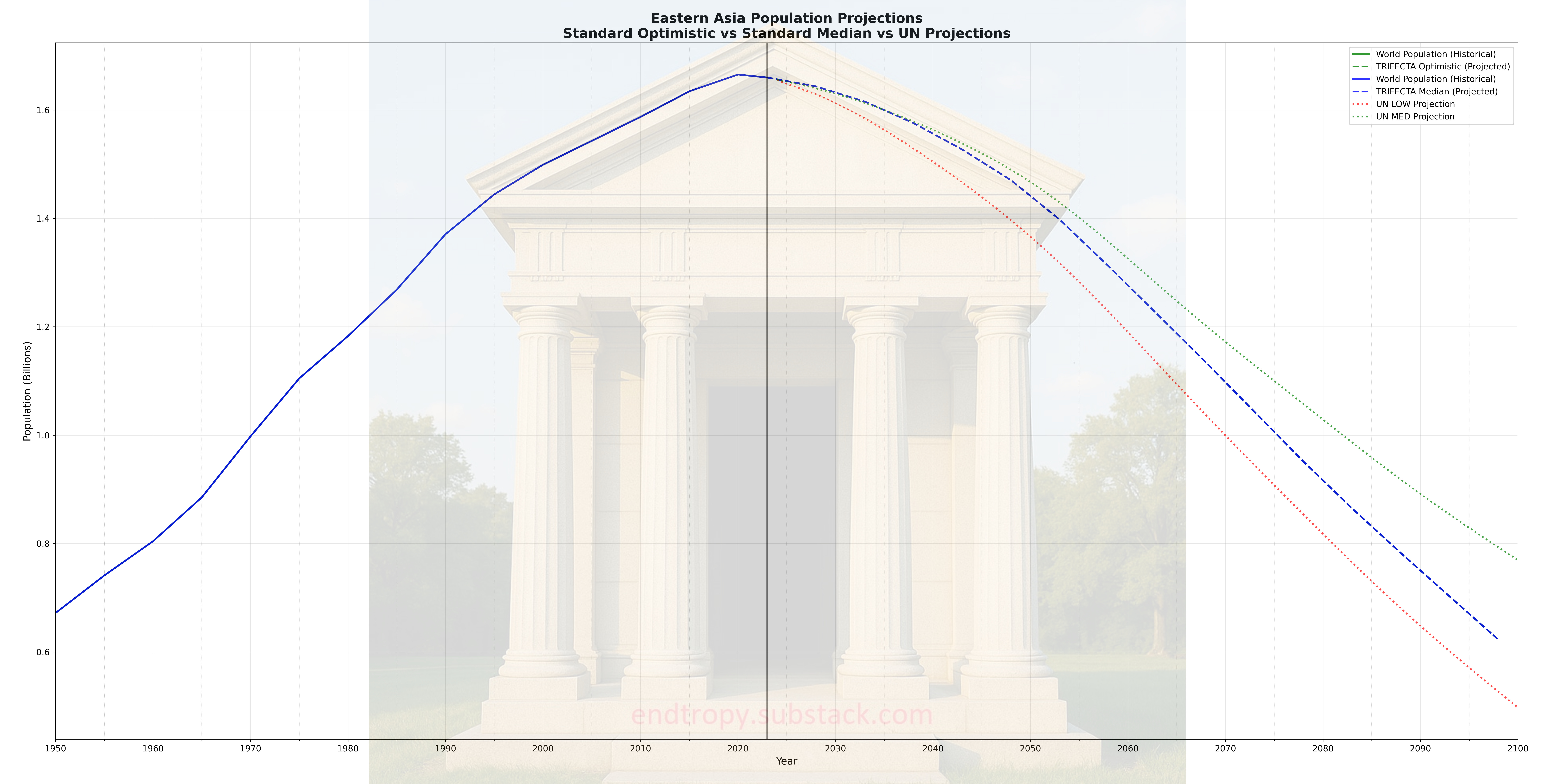
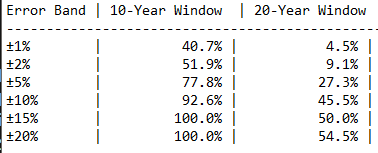
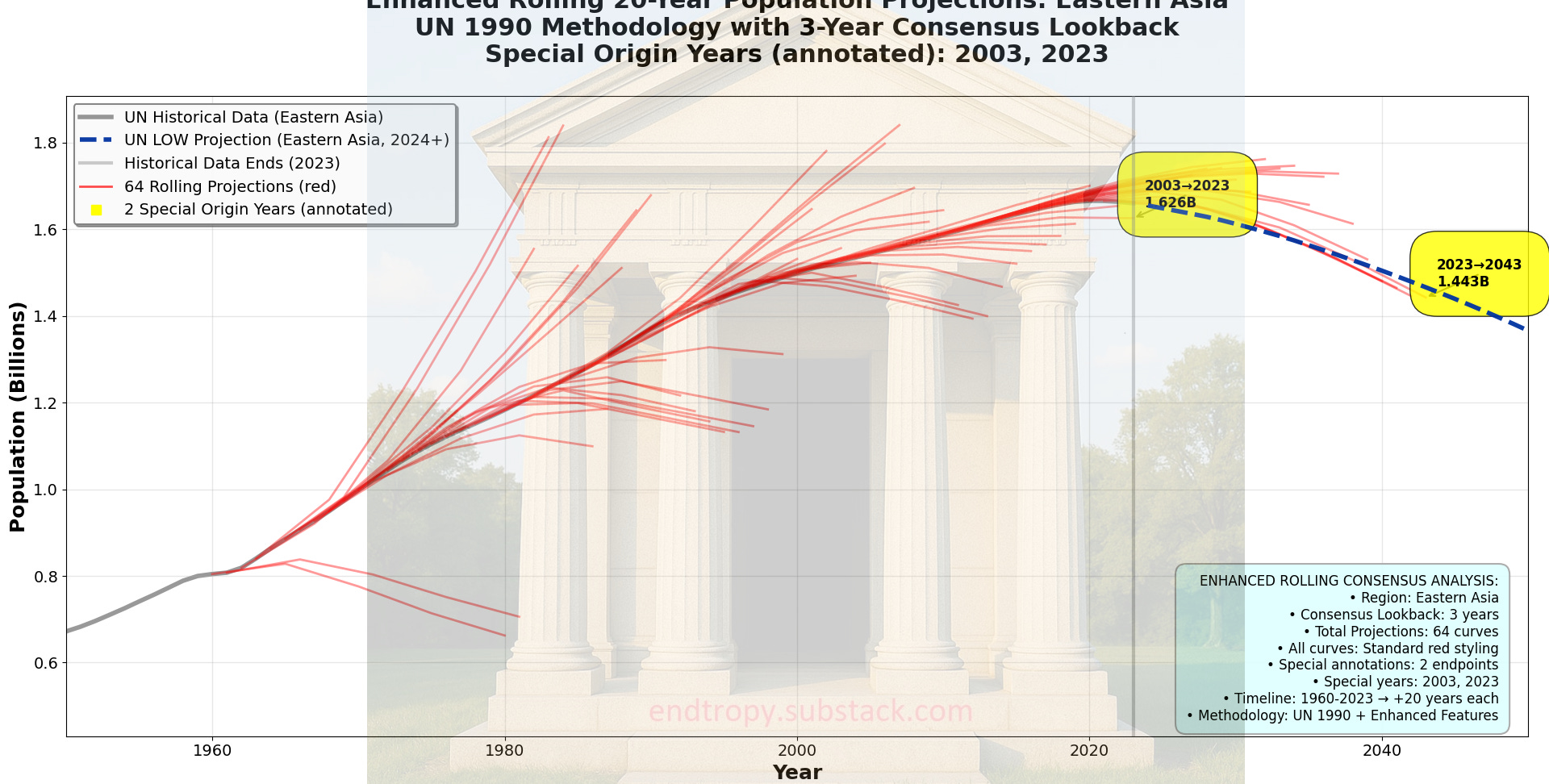
Firstly we need to address the terrible accuracy of Eastern Asia’s predictions. This is where science and math meet exogenous factors. Because formulas alone cannot account for externalities.
1. China had the Red Revolution and the various small wars propagated throughout Eastern Asia. This had the effect of a strong emigration push to leave the region.
2. China’s One Child Policy is well known to have crushed the TFR.
3. Remember that net migration for the world is 0. We cannot move off planet. The terrible accuracy cancels out. Demographic inertia of the globe is strong force and predictable within the 20 year time horizon.
The rolling projection from 2003 – 2023 achieved excellent accuracy once regional turmoil subsided. 2023’s actual population was recorded at 1.66B; The engine producing a 1.626B prediction. This is an underprediction of 2%.
The CIA demographic engine is picking up a very strong negatively trending TFR at present.
We have second demographic engine to be unveiled that improves substantially upon the accuracy results. It achieves a relative increase of +60% over the 20 year window. The +/- 10 error now sits at 73% for 20 years. The slope and endpoint is near identical to 2100 with the current graphs here. Eastern Asia is terminal.
We can see from the curves that the model is not ideologically pessimistic. It is reading higher population curves than both UN MED and LOW. It simply looks like the UN made a linear extrapolation from 2023.
The key difference is that the current implementation of the model has set a TFR FLOOR of 0.8; without this, the curve would decline much like the UN MED/LOW forecasts. We can look at the general curve to Eastern Asia, the UN itself is declaring that this region is under existential demographic threat.
China is in a very dangerous position. By extension, the world is equally imperiled.
China is the primary manufacturing node, it fails, everything fails. China has confirmed 2022 through to now negative population growth. The current % decline equals 10% of Canada’s population per year, their absolute decline is -0.23%. This value should increase mathematically since their old population is larger than their young. More old die, the % total population declining would therefore increase.
China’s economy will struggle with rising dependency ratios and stagflation. The current financial landscape is built for increasing population growth. China will be one of the most interesting real life case studies of how the current economic paradigm can last. We are seeing the real effects of this now as the Chinese property market looks to have retraced all of its recent gains and some areas are seeing values that equal 2007 prices.
If China is to remain a world power in its current state, it must deploy a 2 pronged approached: automation and immigration. And there are few regions that are still increasing in population. China will need to allow these populations to seamlessly integrate into their economy via reskilling and upskilling. You simply need manpower to keep the machines running.
The other way China can escape this is through AI and automation. Such efforts are underway in many countries and not just for reasons of possible demographic decline. AI and automation will be explored more fully in a later analysis. China’s upper leadership may dream of centralized high technocracy. But a nation without people, is one without a strong unifying cultural identity. The same population allows your country to rely upon a closed loop of domestic production and consumption. Being an export economy gives you power over your trading partners, you have what they want. But if those economies weaken, without a core of domestic internal consumption, China itself will economically suffer along with the rest of the world.
The world is rediscovering what resilience actually means. Capitalism optimized for efficiency. Resiliency optimizes via inefficiency instead. Redundancy and modularity are desired. A plane is a complex piece of engineering; and it needs redundancies, the global economy is the same.
In a world where China can’t be trusted to reliably produce things the world economy needs, the obvious answer is to establish reshoring or friendshoring. That trust component may be from China applying trade pressure or simply as a result of their demographic decline. More than likely, both at the same time. As China will see its geopolitical power wane from lack of manpower, it may grow ever more desperate to assert its influence on the world stage.
We will move forward with the analysis on the assumption that China curve via the CIA demographic engine is correct, assumed stagflationary. However keep in mind that for the UN to say outright China’s population has peaked and will irreversibly decline is an incredible statement with myriad implications.
Where East Asia is declining in absolute numbers, their domestic consumption must generally decline as time goes on. This makes the region prone to economic distress resulting from reliance on exports.
We are premature in crowning this as the “Chinese Century.”
The Nobles are still fighting to see who gets the Crown.
PREVIOUS

NEXT

John, your data is correct, but your operating system projection is wrong.
You are modeling System B (China) using the logic of System A (The West). System A requires Biomass Growth (Immigration) to sustain Asset Prices (Real Estate/Stocks). System B prioritizes Industrial Dominance over Asset Prices.
1. The Entropy Rejection (Why No Immigration) You suggest China "must" import labor. System B is designed for Minimum Social Entropy. Importing millions of distinct cultural units creates friction. The TFR crash is the Thermodynamic Imperative to switch from Bio-Labor to Silicon-Labor. System B would rather have 700M people with 500M Robots (Low Entropy, High Output) than 1.4B people with dilute cohesion (High Entropy, Unstable).
2. The "De-Rentier" Pivot You see the Real Estate crash as a "Collapse." We see it as Capital Reallocation. In System A, high asset prices are the goal (to please voters/retirees). In System B, high asset prices are a Tax on Industry. By imploding real estate, System B is ruthlessly transferring wealth from Rentiers (Old Economy) to Makers (New Economy). It lowers the "Unit Cost of Survival" to keep the factories competitive.
3. The Sovereign Venture Capitalist You worry about "Tax Revenue" covering pensions. System B doesn't fund itself via taxes; it funds itself via Monopoly Rents and Sovereign Credit. They are printing "Infinite CAPEX" not to pay pensioners, but to subsidize the complete capture of the Global Supply Chain (Solar, EV, Ships). The plan is simple: Secure the global physical monopoly before the demographic cliff becomes fatal.
System A tries to save the Past (Retirees/Assets). System B is burning the Past to buy the Future.
Ok but don't you think TFR can be improved through policy? Especially in a country like China.