
Operation Epic Folly(Fury) - Part 2: The Punic Wars and Impending Nuclear Escalation
Game Theory: The Interbellum Peace that wasn't.

PREVIOUS

Cognitively, humans have not changed for at least 10 000 years.
Biologically, very little in general has changed since 300 000 years ago.
The saying goes: History doesn’t repeat, but it rhymes.
Because fundamentally, we’re the same stupid humans.
Which makes the future reasonably predictable.
And that’s why this dispatch has a very long historical prelude.
Roman numeral sections are deliberate historical exposition.
We will deliver a post mortem geopolitical result of Epic Fury less than 1 week from start of combat using history, game theory, and engineering.
If you are only interested in Operational Intelligence, skip to the section:
1.0 Opportunity Wasted
The Second Punic War
I. A Young Boy’s Oath
Before there was a war, there was a boy and his father’s hand on his shoulder.
Hamilcar Barca, the undefeated Lion of Carthage, had watched his city kneel.
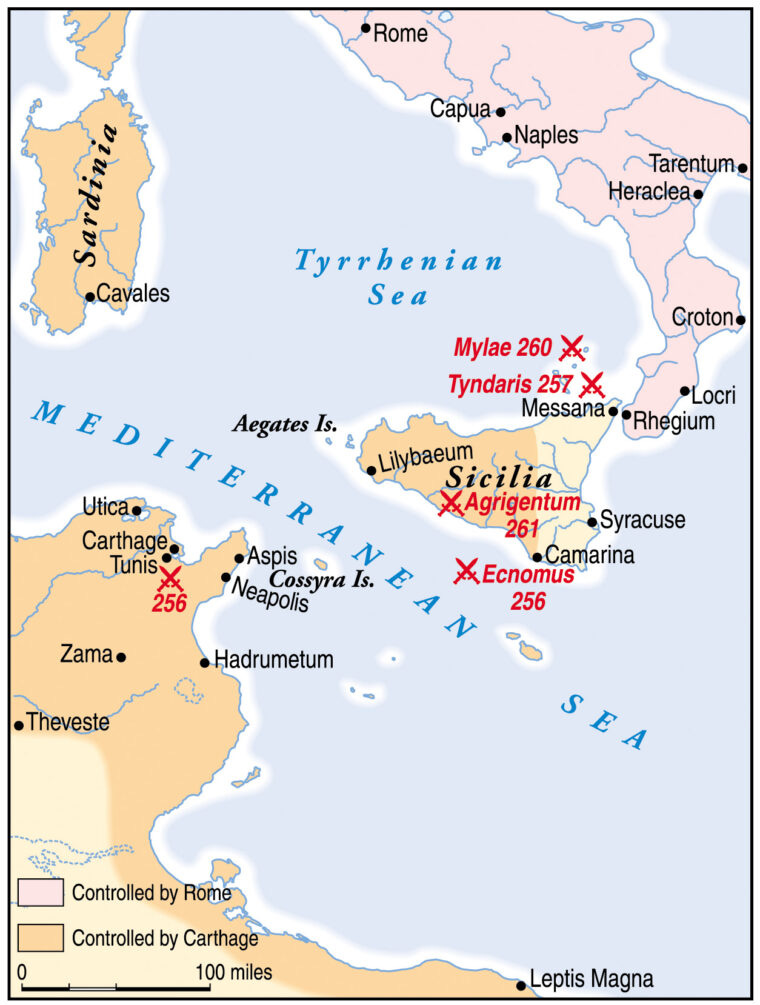
The First Punic War had ended not because Rome had broken Carthage on the battlefield, Hamilcar had never lost in Sicily.
But because Carthage’s merchant senate had grown tired of paying for it.
They sued for peace.
They surrendered Sicily.
They paid the indemnity.
And when their own mercenaries revolted over back wages, it was Hamilcar who put down the revolt and saved the city that had abandoned him.
Rome, smelling weakness, then seized Sardinia and Corsica in open violation of the treaty.
There was no pretext.
There was no provocation.
Carthage was in no position to resist, and Rome knew it.
The seizure was pure opportunism dressed in the thinnest legal cloth, and it taught Hamilcar something that his son would carry for the rest of his life:
Rome did not negotiate.
Rome consumed.
Treaties were not endpoints but pauses, intervals in which Rome digested what it had already taken and positioned itself to take more.
“Hamilcar, when he was about to take his son Hannibal with him to Spain, led the boy to the altar and made him lay his hand on the sacrifice and swear that, as soon as he was able, he would be the enemy of the Roman people.”
Livy – Ab Urbe Condita (History of Rome), Book 21, Chapter 1
Hamilcar drowned crossing a river in 228 BC, still fighting, still building.
His son-in-law Hasdrubal the Fair took command, expanded the Spanish territories through diplomacy, and was assassinated by a Celtic servant in 221 BC.
The army made the logical choice of the next commander.
Hannibal was twenty-five years old.
II. Crossing the Alps
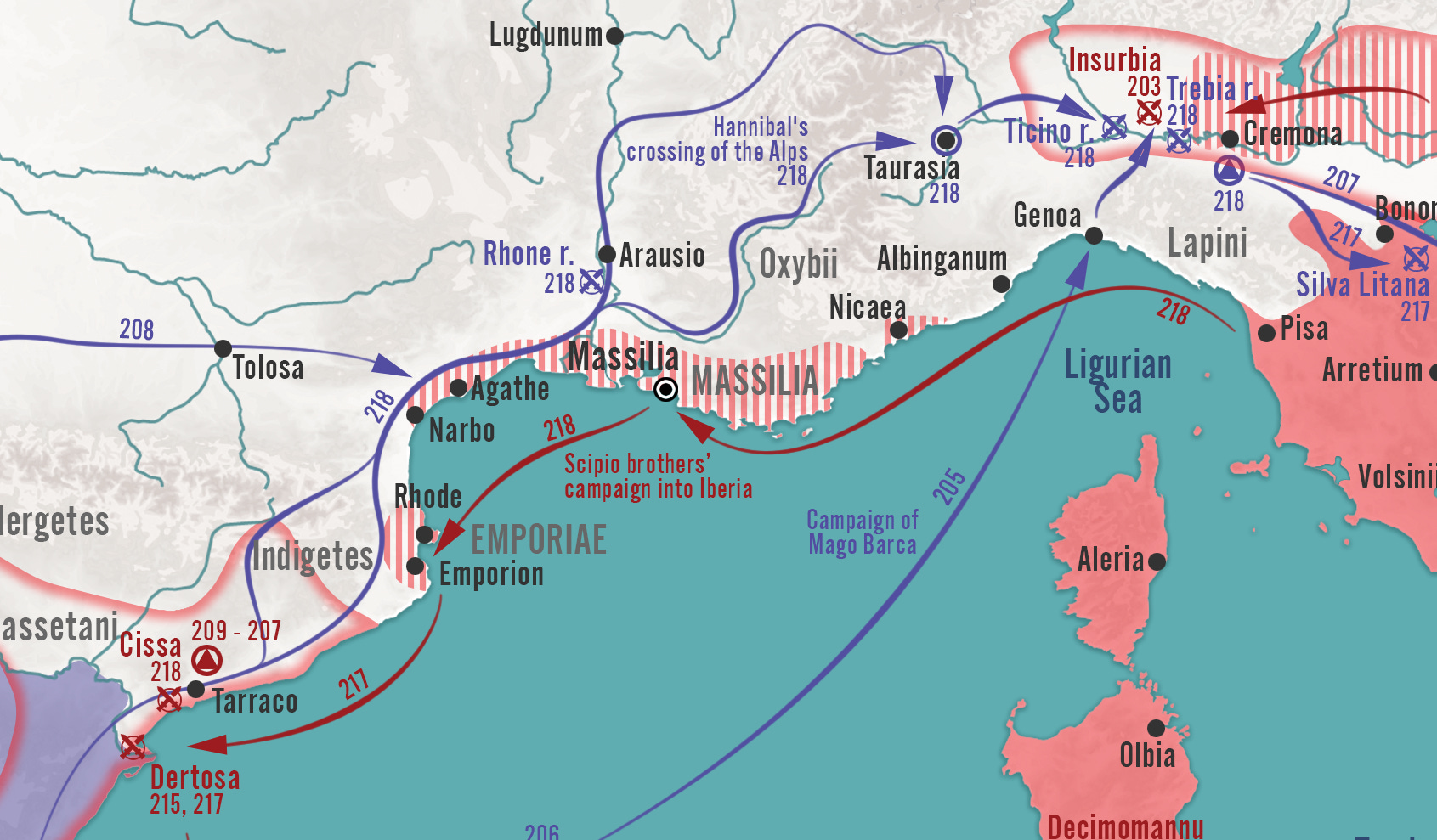
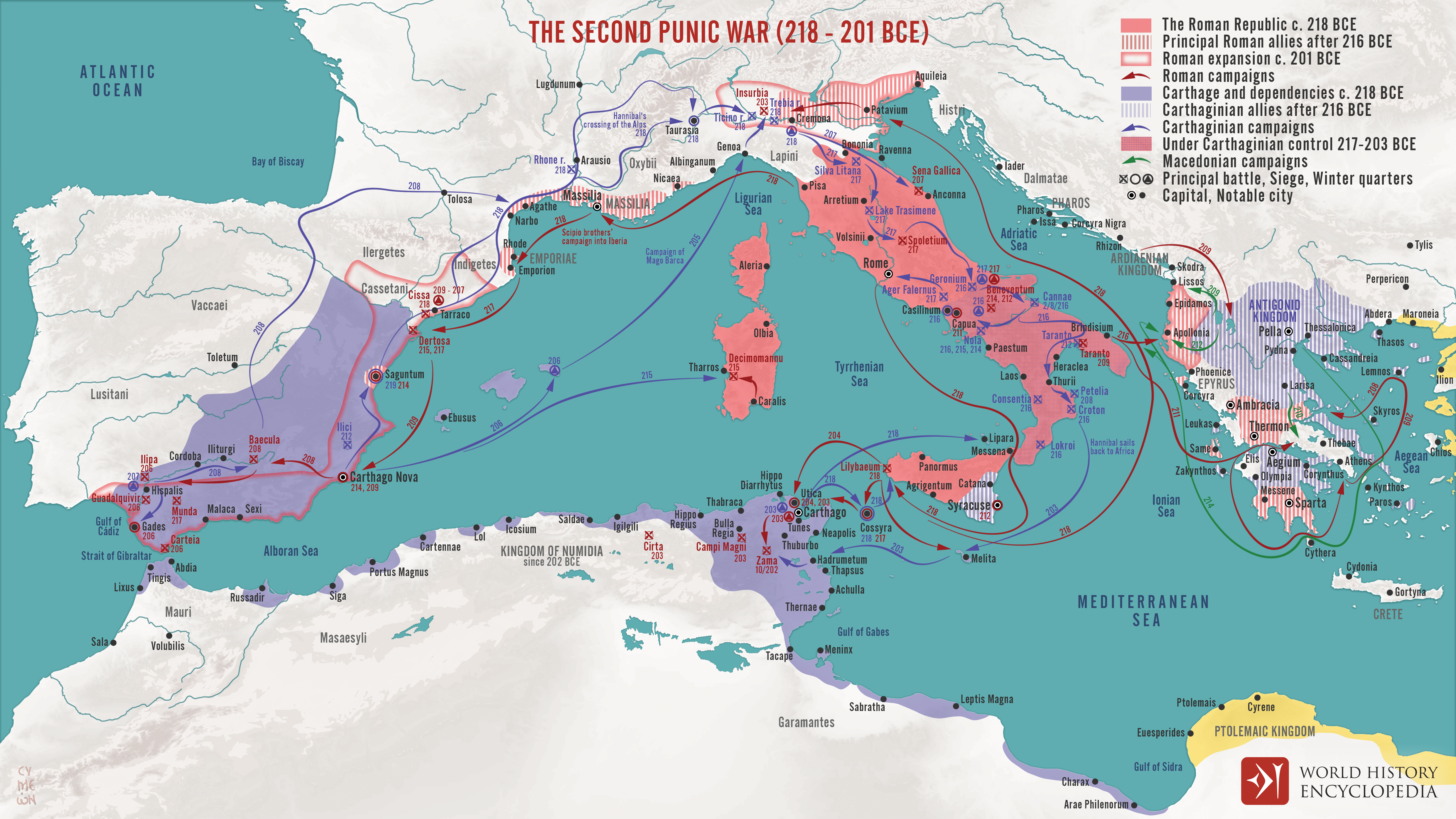
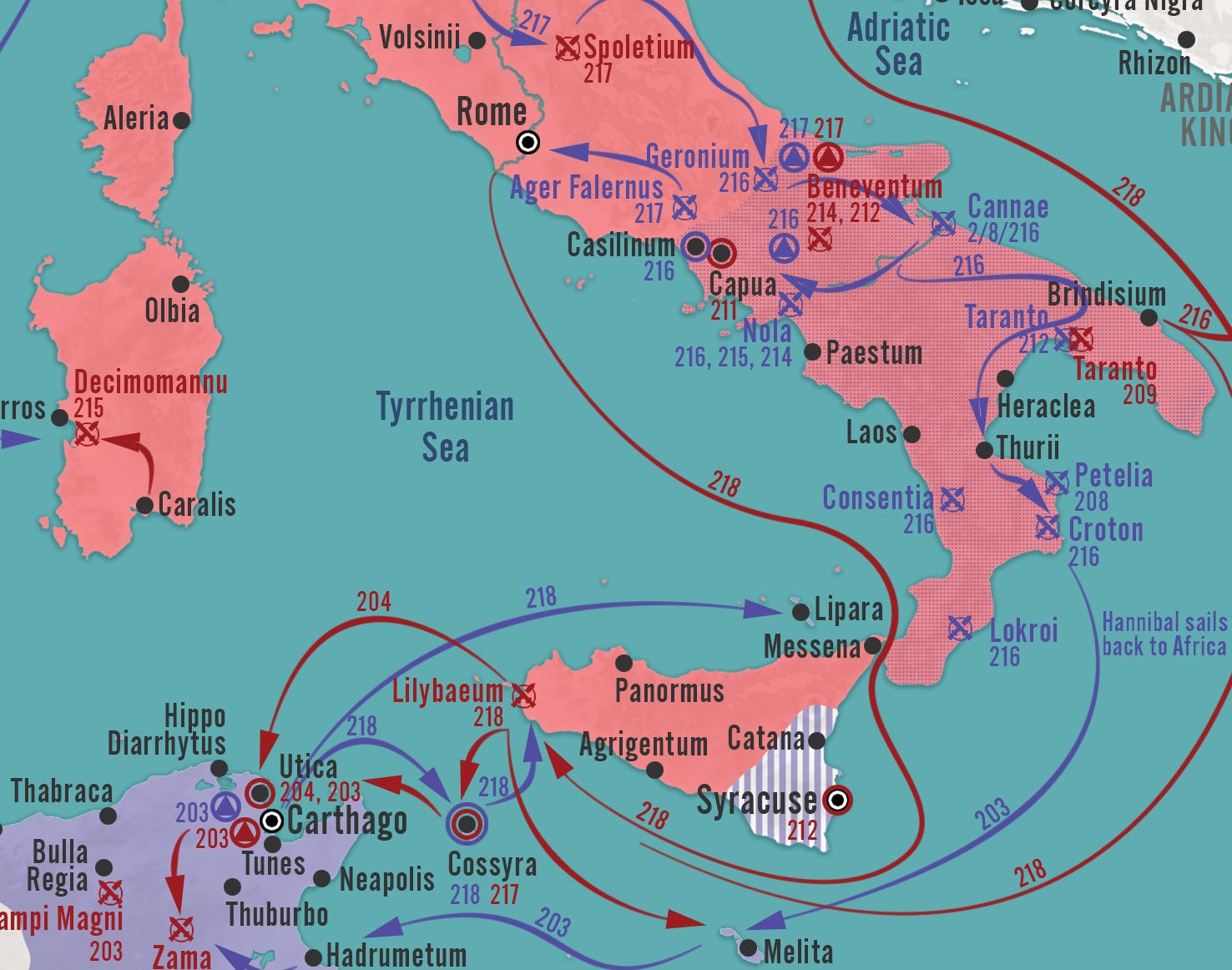
In the spring of 218 BC, Hannibal departed New Carthage with approximately 90,000 infantry, 12,000 cavalry, and 37 war elephants.
He was marching to Italy, but not by sea.
Rome controlled the western Mediterranean, and Carthage’s navy had never recovered from the First Punic War.
He was going over land.
Over the Pyrenees.
Across southern Gaul.
And then over the Alps.
No one had done this with an army.
The logistics alone were considered impossible.
The Alpine passes in late autumn were choked with early snow, the trails narrow enough that a single stumbling pack animal could take a file of men off a cliff face.
Hostile mountain tribes rolled boulders onto the column from above.
Elephants, creatures of African heat, shivered and died on frozen scree.
Polybius, who later walked portions of the route himself, records that Hannibal entered the Alps with roughly 50,000 infantry and 9,000 cavalry.
He emerged on the Italian side with 20,000 infantry, 6,000 cavalry, and a handful of surviving elephants.
He had lost more than half his army to cold, starvation, rockfall, and geography.
Any rational assessment would have called the campaign finished before it began.
Hannibal was deep in enemy territory with a battered remnant, no supply line, no reinforcements, and no line of retreat.
Rome had nearly 800,000 men of military age available across its confederation.
Within months, Hannibal had destroyed two Roman armies.
III. Unstoppable
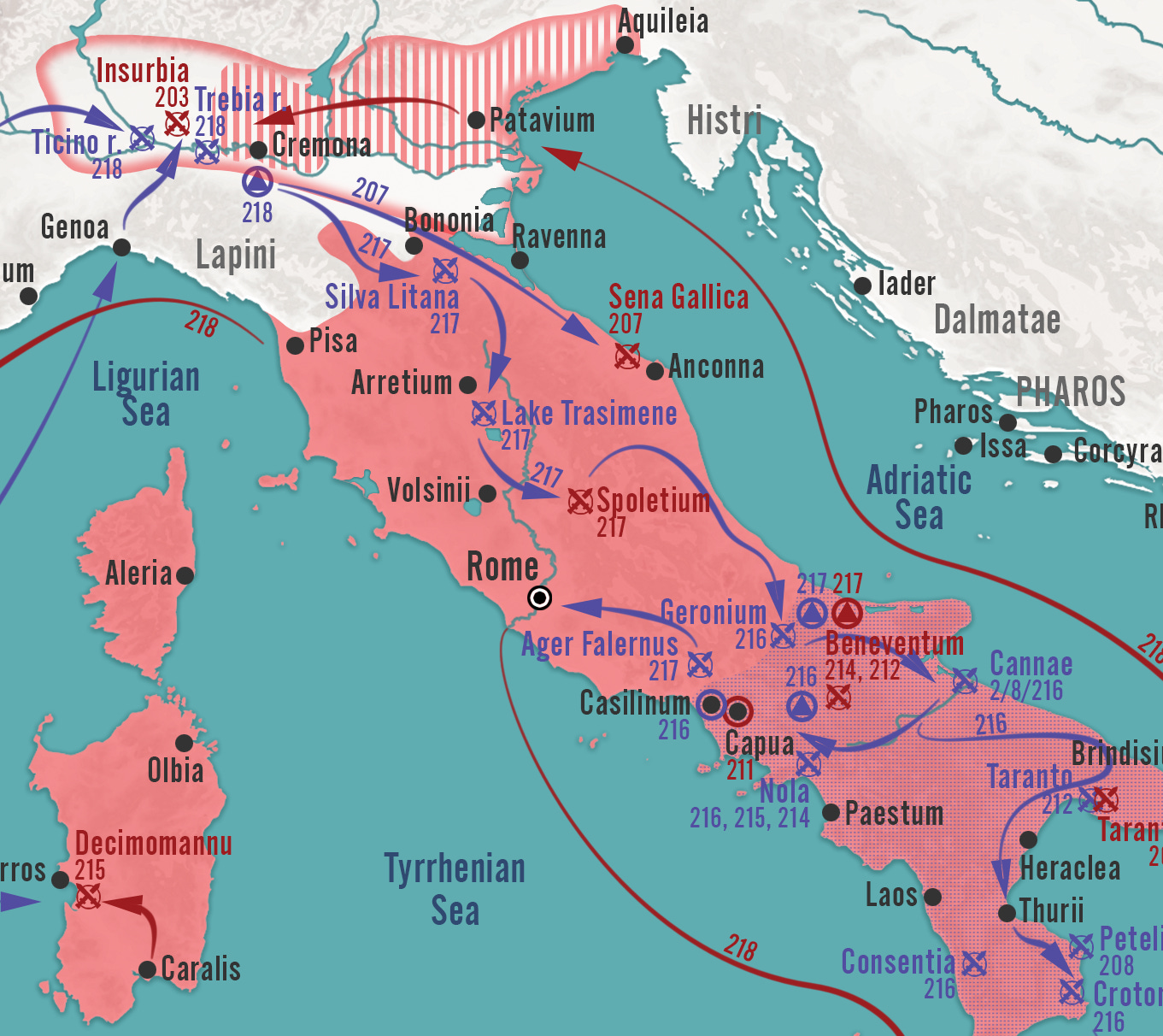
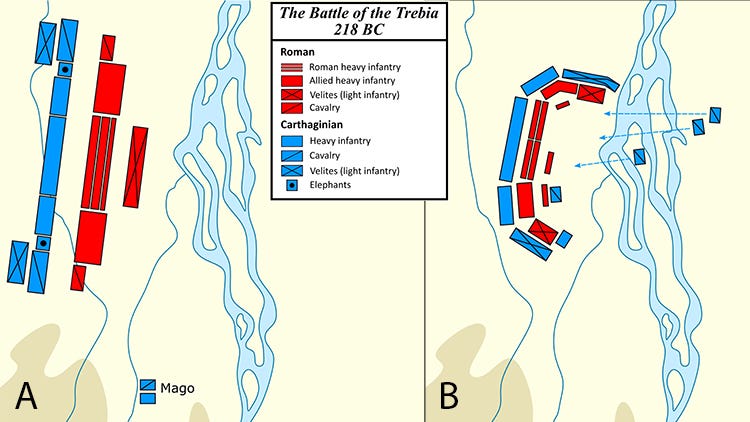
At the Trebia in December 218 BC, Hannibal baited the Roman consul Tiberius Sempronius Longus into attacking across a freezing river at dawn, stomach-empty, while a concealed force under his brother Mago struck the Roman rear.
Roman losses were catastrophic.
The most dramatic reported losses come from Livy, who claims nearly the entire Roman army of 30,000+ dead or captured, with only 10,000 escaping.
Sempronius, humiliated, understated the disaster in his report to the Senate.
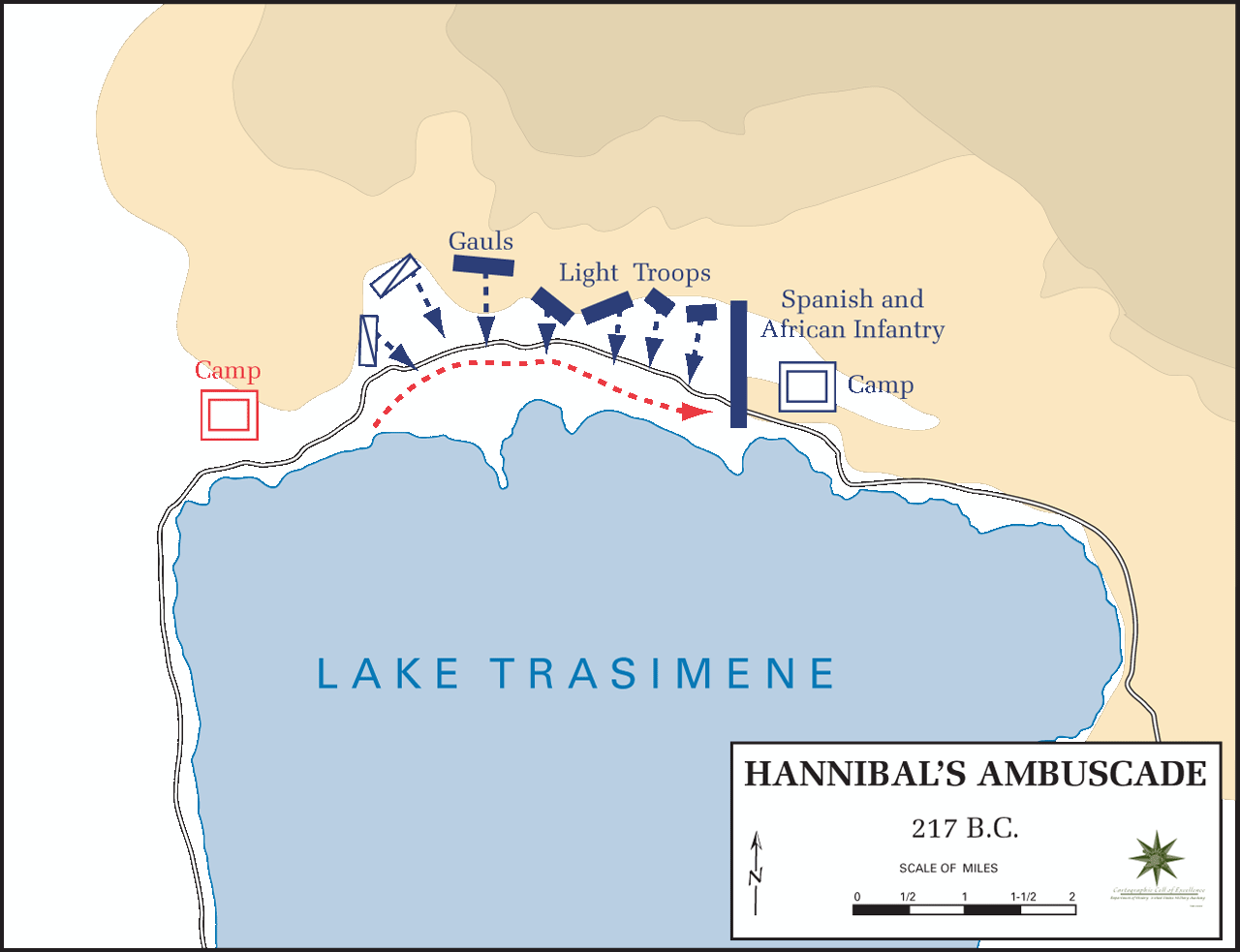
At Lake Trasimene in June 217 BC, Hannibal executed what remains the largest successful ambush in recorded military history.
He concealed his entire army of 50,000 men, in the hills and morning fog along the northern shore of the lake and waited for the consul Gaius Flaminius to march his army of roughly 25,000 into the defile between the hills and the water.
The trap closed in three hours.
Flaminius was killed.
Approximately 15,000 Romans died, many drowning in the lake as they tried to flee.
Another 10,000 were captured.
Hannibal lost perhaps 1,500 men.
This was one of Rome’s largest military defeats ever to that point.
Until Cannae.
Rome was in panic.
For the first time in living memory, the Senate appointed a dictator: Quintus Fabius Maximus, an older senator known for caution.
Fabius understood something that the dead consuls had not.
Hannibal could not be beaten in open battle.
Not because he had a larger army, but because he was operating at a level of tactical sophistication that Roman commanders simply could not match.
Hannibal could read terrain the way a poet reads meter.
He understood that battles were won before the first javelin was thrown, in the selection of ground, in the manipulation of his enemy’s psychology, in the creation of conditions that made the outcome feel inevitable only in retrospect.
Fabius refused to fight.
He shadowed Hannibal’s army through southern Italy, staying on high ground, harassing foragers, cutting off stragglers, never offering the pitched battle that Hannibal wanted.
The Fabian strategy, the name it still carries twenty-three centuries later, was militarily sound and politically suicidal.
Rome did not elect dictators to watch.
The Senate seethed.
The public mocked Fabius as “Cunctator”.
The Delayer
His own Master of Horse, Marcus Minucius Rufus, was so contemptuous of the strategy that the Senate took the unprecedented step of granting Minucius equal command.
Minucius promptly attacked Hannibal, was nearly destroyed, and was rescued only by Fabius marching to his aid.
Minucius, to his credit, publicly acknowledged his error and returned command.
But the political damage was done.
Rome wanted blood, not patience.
When Fabius’s term expired, the Senate elected two new consuls for 216 BC: Gaius Terentius Varro and Lucius Aemilius Paullus.
Rome raised the largest army it had ever fielded, Polybius gives approximately 80,000 infantry and 6,000 cavalry across eight reinforced legions.
They marched south to find Hannibal.
They found him near a village called Cannae.
IV. Battle of Cannae
August 2, 216 BC. The plain near the Aufidus River in Apulia.
The day was hot and a seasonal wind called the Volturnus blew from the south, carrying dust into the faces of the Roman lines.
Hannibal had chosen the ground.
He had always chosen the ground.
The Roman formation was conventional but modified for overwhelming force.
Varro, who held command that day, the consuls alternated daily, compressed the infantry into an unusually deep formation, reducing the frontage and increasing the mass.
The logic was simple: concentrate everything into a single overwhelming thrust that would punch through Hannibal’s center by sheer weight of flesh and iron.
Eighty thousand men, packed shoulder to shoulder, shields overlapping, the rear ranks literally pushing the front ranks forward through the pressure of bodies.
On paper, it should have worked.
Hannibal had roughly 40,000 infantry and 10,000 cavalry.
He was outnumbered nearly two to one in foot soldiers.
His cavalry advantage was significant, his 10,000 horse against Rome’s 6,000, but cavalry didn’t win ancient battles against disciplined heavy infantry.
Or so the Romans believed.
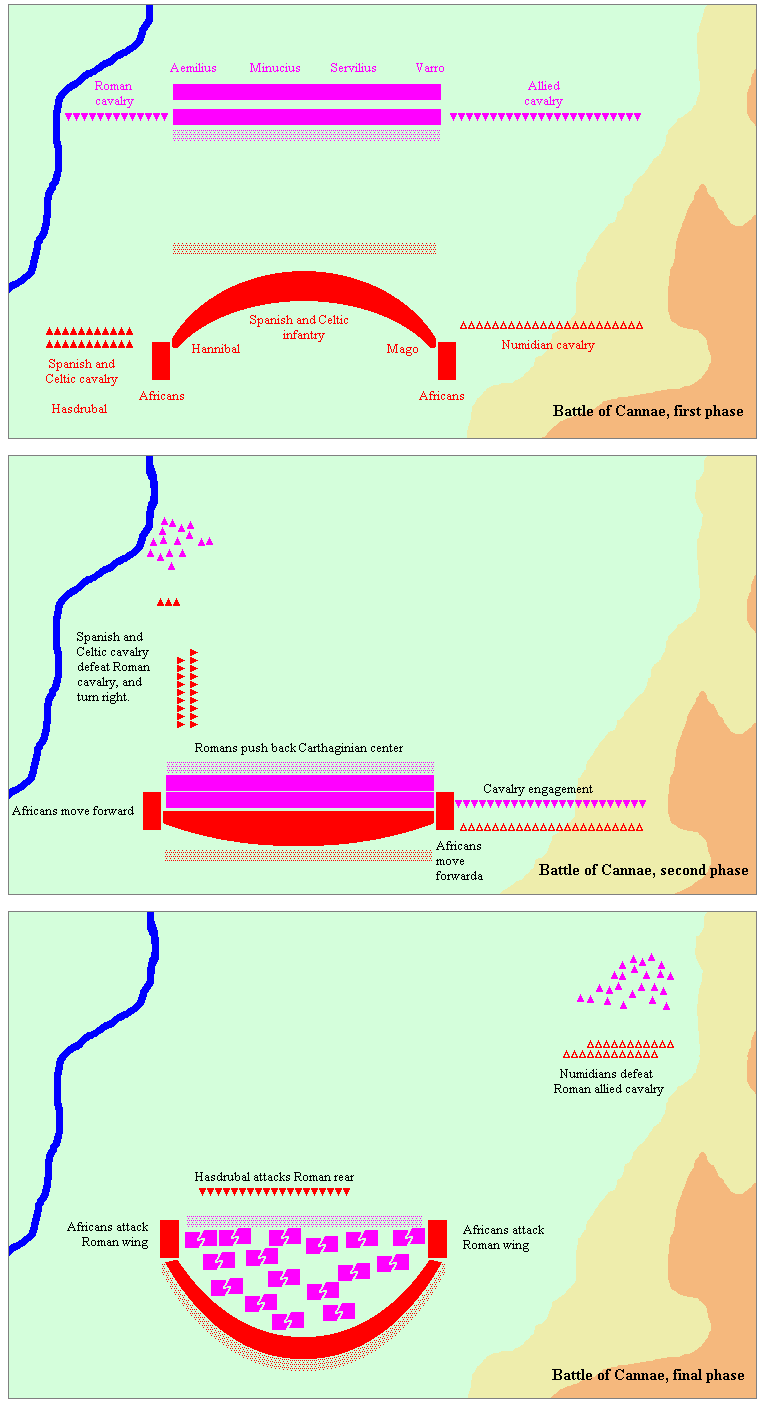
Hannibal arranged his center in a convex arc, a bow shape bulging toward the Romans.
In the center of this arc he placed his least reliable troops: the Gauls and Spanish infantry, lightly armored, brave but brittle.
On the flanks of this arc, echeloned back and concealed by the curvature, he placed his elite African heavy infantry, veterans armed with Roman weapons and armor stripped from the dead at Trebia and Trasimene.
On the far wings, his Numidian and Spanish cavalry under Maharbal and Hasdrubal.
The Romans advanced.
The center of Hannibal’s line gave ground, exactly as it was designed to do.
The convex arc flattened, then inverted, becoming concave; a crescent opening toward the Roman mass.
The Romans, seeing the enemy center retreating, pushed harder.
The deep formation that Varro had designed to generate irresistible force now worked against itself: the rear ranks drove the front ranks deeper into the pocket, compressing laterally, losing the ability to use their weapons.
Men in the interior of the formation could not raise their arms to swing a sword.
And then the jaws closed.
The African infantry on both flanks wheeled inward and struck the Roman flanks.
Maharbal’s cavalry, having routed the Roman horse wing, completed the circuit and slammed into the Roman rear.
Eighty thousand men were surrounded on an open plain.
What followed was not a battle.
It was systematic annihilation.
Polybius, who had access to eyewitness accounts and was himself a military professional, records approximately 50,000 Roman dead.
80,000 if we include Roman Allies.
To grasp the scale: more Romans died at Cannae in a single afternoon than Americans died in the entire Vietnam War.
Based on population estimates, this may have amounted to 50% of all the current Roman enlisted men in direct combat roles.
The killing took most of the day because the logistics of slaughtering eighty thousand surrounded men with swords, spears, and bare hands is exhausting physical labor.
Ancient sources describe Carthaginian soldiers so fatigued from killing that they had to be rotated out of the perimeter to rest.
Consul Paullus was killed.
Proconsul Gnaeus Servilius Geminus was killed.
Marcus Minucius Rufus, the same man Fabius had rescued from his own rashness, was killed.
Eighty senators or men of senatorial rank were killed.
The equestrian class was gutted.
Golden rings taken from the Roman dead, the mark of equestrian rank, supposedly filled three and a half modii, a Roman unit of dry measure.
3.5 modii is roughly 30 liters.
A medium moving box (the standard Home Depot/U-Haul “medium” box) filled to the brim. These boxes are usually around 18” × 18” × 16”; very close to 30–32 liters.
Two full 5-gallon buckets (the orange Home Depot buckets). Each holds 18.9 liters, so two of them = 37.8 liters. 30.5 liters is a bit less than that; roughly 1.6 full 5-gallon buckets.
Final estimated value in current USD: $40 Million.
Livy records this detail with the caveat that some historians considered the number exaggerated, but even the lower estimates represent a staggering percentage of Rome’s governing class lying in the Apulian dirt.
Varro survived.
He escaped with approximately 14,000 men, the shattered remnants of the largest army Rome had ever assembled.
He retreated to Venusia.
When he eventually returned to Rome, the Senate, in a gesture that speaks volumes about Roman institutional character, went out to meet him at the city gates and formally thanked him for not having despaired of the Republic.
They thanked him for coming home, because so few did.
V. Hannibal ante portas, or not.
In the aftermath, as the scale of the Roman catastrophe became clear, Hannibal’s cavalry commander Maharbal urged an immediate march on Rome.
The city was five days away.
Its garrison was minimal.
The field army that could have defended it was decomposing in the August heat on the plains of Cannae.
What happened next is one of the most debated moments in military history.
Livy gives us the famous exchange.
Maharbal argued that if Hannibal advanced immediately, he could dine on the Capitol within five days.
Hannibal hesitated.
He praised the idea but said the matter required deliberation.
Maharbal replied:
“You know how to gain a victory, Hannibal.
But you do not know how to use one.”
Why?
The ancient sources offer one explanation: caution, fatigue, the difficulty of besieging a walled city without siege equipment.
Modern military historians have added logistical arguments.
Hannibal’s army was exhausted, his supply lines nonexistent, Rome’s walls were formidable, and a failed siege would have been catastrophic.
These arguments are not wrong.
But they may be insufficient.
Hannibal’s strategic objective was never the physical destruction of Rome.
It was the dissolution of Rome’s confederation, the network of alliances and subject relationships that gave Rome access to the Italian peninsula’s vast manpower reserves.
Cannae was supposed to be the demonstration that proved Rome could not protect its allies.
The theory was that after a sufficiently catastrophic defeat, Rome’s Italian allies would defect to Hannibal, the confederation would collapse, and Rome would be reduced to a single city-state that could be dictated terms.
And in the immediate aftermath of Cannae, this theory appeared to be working.
Capua, the second-largest city in Italy, defected to Hannibal.
Much of southern Italy followed; Lucania, Bruttium, parts of Samnium, the major Greek cities of Tarentum and Metapontum.
For a brief window, the strategic vision seemed achievable.
But the core of the Roman confederation held.
The Latin colonies did not defect.
Central Italy remained loyal.
And Rome itself responded to the worst military disaster in its history not with negotiation, not with terms, not with accommodation, but with a refusal so total that it became the defining characteristic of the Roman state.
The Senate refused to ransom the prisoners.
This was not a bureaucratic oversight.
Hannibal offered to return approximately 8,000 Roman prisoners of war for a modest ransom.
The Senate debated and declined.
Those citizens, soldiers, sons; were written off because accepting the ransom would have acknowledged the legitimacy of the defeat.
Rome’s position, in the face of fifty thousand dead, was that there was nothing to discuss.
They then did something that should have been impossible.
They raised new legions.
Boys of sixteen and seventeen were enlisted.
Slaves were offered freedom in exchange for military service, 8,000 volones, volunteer slaves, were armed.
Criminals were released into service.
The property qualification for military service was lowered.
Within a year of losing the largest army in their history, Rome had more men under arms than before Cannae.
VI. The Long Withering
Hannibal remained in Italy for thirteen more years.
Thirteen years.
The man who had executed the most perfect battle of annihilation in human history, spent thirteen years in southern Italy winning engagements that no longer mattered.
Hannibal was waiting for reinforcements that never came in sufficient strength, watching his strategic position erode one season at a time.
Rome had learned.
After Cannae, no Roman commander offered Hannibal a pitched battle on his terms again.
The Fabian strategy, the strategy Rome had mocked, the strategy that had cost Fabius his political career, became the default Roman approach.
Shadow Hannibal.
Fortify the towns.
Starve his supply lines.
Recapture the defectors one by one.
Never, ever, give the lion a fight he could win.
The Roman commander who emerged in this period was Marcus Claudius Marcellus the “Sword of Rome,” as Plutarch called him, to Fabius’s “Shield.”
Marcellus was aggressive enough to engage Hannibal in limited actions, skilled enough to avoid catastrophic defeat, and relentless enough to keep pressure on Hannibal’s allied cities.
He besieged and sacked Syracuse in 212 BC, killing the mathematician Archimedes in the process, an act that Rome’s own historians recorded with something approaching shame.
Marcellus fought Hannibal directly at Numistro and again at Canusium, battles that ended inconclusively but demonstrated that Roman commanders were learning to survive contact with the master.
Marcellus was killed in an ambush in 208 BC.
Hannibal reportedly gave him funeral honors.
The war consumed the best of both sides.
Meanwhile, Rome methodically recaptured the cities that had defected after Cannae.
Capua fell in 211 BC after a brutal siege.
Hannibal marched on Rome itself, his only direct approach to the city, in an attempt to draw the besieging legions away.
The gambit failed.
The Romans refused to break the siege.
Hannibal rode up to the Colline Gate, threw a javelin over the walls in a gesture of contemptuous defiance, and turned back south.
According to Livy, the land on which Hannibal’s army was encamped outside Rome was sold at auction during his presence there, and fetched its full market price.
The Romans were making a statement: you do not frighten us enough to devalue our real estate.
When Capua fell, Rome’s retribution was systematic.
The Capuan senate was executed.
The population was sold into slavery.
The city was stripped of political existence, it continued as a physical location but ceased to be a polity.
Every city in Italy that was considering defection to Hannibal received the message:
Rome does not negotiate.
Rome does not forgive.
Rome does not forget.
The cost of betrayal is annihilation.
Tarentum was retaken in 209 BC through treachery and brute force.
The Greek cities of the south returned to Roman control.
The territory Hannibal had gained after Cannae shrank year by year, a tide going out with agonizing slowness.
VII. The Brother’s Head
In 207 BC, the strategic situation shifted.
Hannibal’s brother Hasdrubal, who had been fighting a separate war against the Romans in Spain, crossed the Alps with a fresh army, retracing his brother’s route of eleven years earlier.
If the two armies united, Hannibal would have the reinforcements he had needed for a decade.
The brothers planned to join forces in central Italy.
They never met.
The consul Gaius Claudius Nero, not the later emperor, but an ancestor of the same family; was shadowing Hannibal in the south when intercepted communiques revealed Hasdrubal’s route and timetable.
Nero made one of the most audacious decisions of the war: he left a screening force to watch Hannibal and force-marched north with his best troops approximately 7,000 men.
He went to reinforce his co-consul Marcus Livius Salinator, who was facing Hasdrubal at the Metaurus River.
The march covered roughly 250 miles in seven days.
When Nero’s men arrived, they joined Salinator’s army without Hasdrubal’s knowledge.
The combined Roman force attacked.
Hasdrubal realized he was facing two consular armies, not one.
He attempted to withdraw across the Metaurus at night.
His guides deserted him.
The river crossing failed.
At dawn, the Romans caught him.
Hasdrubal fought well.
When he saw the battle was lost, he rode his horse into the densest concentration of Roman soldiers and died fighting.
He was, by every ancient account, a brave man.
After the battle, Nero marched south faster than the news could travel.
He arrived back at his camp opposite Hannibal with a trophy.
Roman cavalry rode to the edge of Hannibal’s camp and threw an object through the outpost line.
It was Hasdrubal’s head.
Livy records that Hannibal looked at his brother’s face and said: “I see the fate of Carthage.”
With Hasdrubal dead and the reinforcing army destroyed, Hannibal’s position in Italy was terminal.
He could not be reinforced.
He could not be resupplied.
He could win every skirmish for the rest of his life and still lose the war, because Rome could replace its losses and he could not.
He retreated to Bruttium, the toe of the Italian boot, and held out for four more years.
Rome left him there, contained, irrelevant, the most dangerous man in the world reduced to a regional nuisance.
VIII. Scipio
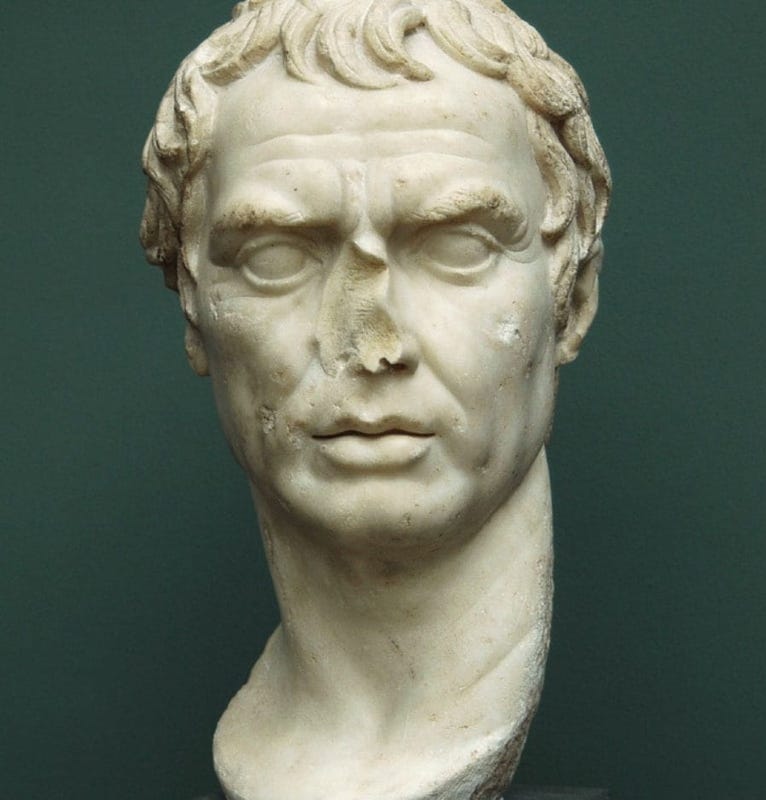
Publius Cornelius Scipio, later called Africanus, had been seventeen years old at Cannae. Whether he was physically there is an answer lost to history.
His name would be recorded in history as a strategist who could think on Hannibal’s level.
His father and uncle had been killed fighting the Carthaginians in Spain.
He understood Rome’s war at the level of personal loss.
In 210 BC, at the astonishing age of twenty-five, too young for the command by every norm of the Roman political system, Scipio was given charge of the Spanish theater.
The same age as Hannibal when he took the reign’s of his father’s army.
“Many were shocked not only by his youth, but also by his appearance and manner of life. They said he walked about the gymnasium in a Greek cloak and sandals, and spent his time among athletes and books… He was accused of being more like a Greek than a Roman.”
Livy (History of Rome, Book 26)
Most shockingly, he grew his hair long in the manner of the Hellenes.
Clearly a sign of his youth and admiration for exotic cultures.
Incredibly disrespectful of Roman Values.
Would the troops even obey his commands?
And yet...
Within four years, he had driven the Carthaginians entirely out of the Iberian Peninsula, using tactics that openly borrowed from Hannibal: flanking maneuvers, cavalry envelopments, the exploitation of terrain and psychology.
He was, in a sense, Hannibal’s most devoted student; a man who had studied the master’s methods and learned to turn them against their source.
In 204 BC, Scipio did what Rome’s cautious Senate had resisted for years: he took the war to Africa.
He landed near Utica with approximately 25,000 men and opened a new front on Carthaginian home soil.
The political effect was immediate.
Carthage, which had failed to adequately support Hannibal for over a decade, suddenly found the war at its own gates and recalled its greatest general from Italy.
Hannibal obeyed.
After a lonely decade on Italian soil, years that had begun with the impossible crossing of the Alps and the annihilation of Roman armies, and ended with his army penned in Bruttium watching the war slip away, Hannibal sailed for Africa.
Livy records that as his ship pulled away from Italian shores, Hannibal looked back at the coastline and cursed the politicians and the merchant class of Carthage who had starved him of men and supplies while he fought their war for them with his father’s army and his father’s oath.
It would not be the last time Hannibal muttered curses at the merchant class.
The Carthaginian Senate had treated the Italian campaign as an inconvenience to be managed rather than a war to be won.
They sent reinforcements in trickles when rivers were needed.
They diverted resources to minor theaters in Spain and Sardinia.
They never committed to the campaign that their greatest general was fighting in their name.
Hannibal crossed an ocean to save a city that never deserved him.
IX. Zama
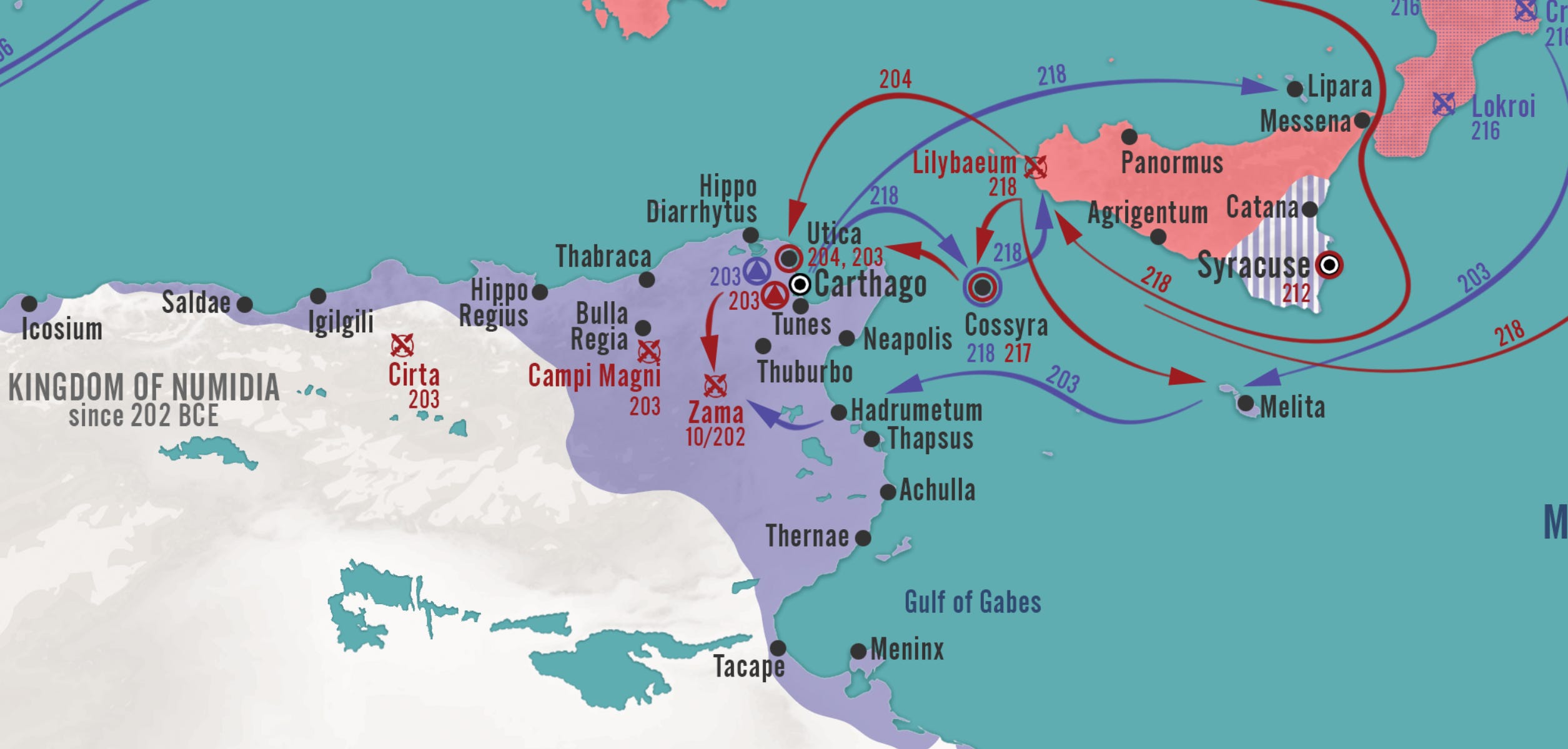
In October 202 BC, the two armies met on the plain of Zama, roughly five days’ march southwest of Carthage.
Before the battle, Hannibal requested a meeting with Scipio.
The two greatest military minds of their age spoke face to face, alone except for their interpreters, between the lines of their assembled armies.
The Meeting Before Zama
Here is the actual dialogue from Livy, taken directly from Ab Urbe Condita (History of Rome), Book 30, Chapters 30–31.
Hannibal - speaking first:
“If the gods had granted that the Roman people should remain content with the empire of Italy and we with that of Africa, we might perhaps have been friends.
But since you Romans have crossed into Africa and we have crossed into Italy, it is now time to end the war.
I am the same Hannibal who fought at the Trebia and Lake Trasimene and Cannae.
You are the same Scipio who defeated Hasdrubal in Spain.
I am prepared to make peace on these terms: Carthage shall keep Africa, and you shall keep Italy and all your other provinces.
We will give up Spain and the islands.
We will pay you a large indemnity.
Let us both be content with these terms, and let this be the end of our quarrel.”
Scipio - replying:
“Hannibal, if you had offered these terms before I crossed into Africa, I might have accepted them.
But now that I have crossed into Africa and you have been defeated in battle, the situation has changed.
You are offering us what we already possess by right of conquest.
You would keep Africa, which you no longer control, and give up Spain and the islands, which we have already taken from you.
The Roman people will accept no peace unless you surrender unconditionally.
You must give up your arms, your ships, and your elephants, pay a full indemnity, and submit to whatever terms we impose.
There is no middle way.
Either you surrender completely, or we fight.”
Hannibal was fighting for Carthage’s existence.
Scipio was fighting to end the war on terms that Rome would accept.
No agreement was reached.
At Zama, the roles were reversed.
Hannibal, for the first time in his career, fought with inferior cavalry.
Scipio’s Numidian allies, under Masinissa, gave Rome the cavalry advantage that Hannibal had used to such devastating effect at Cannae.
The drama of how and why Masinissa was flipped to Roman allegiance is a story worth telling itself but for brevity we will abstain. It had to do with the politicians, again, always ruining things for Hannibal.
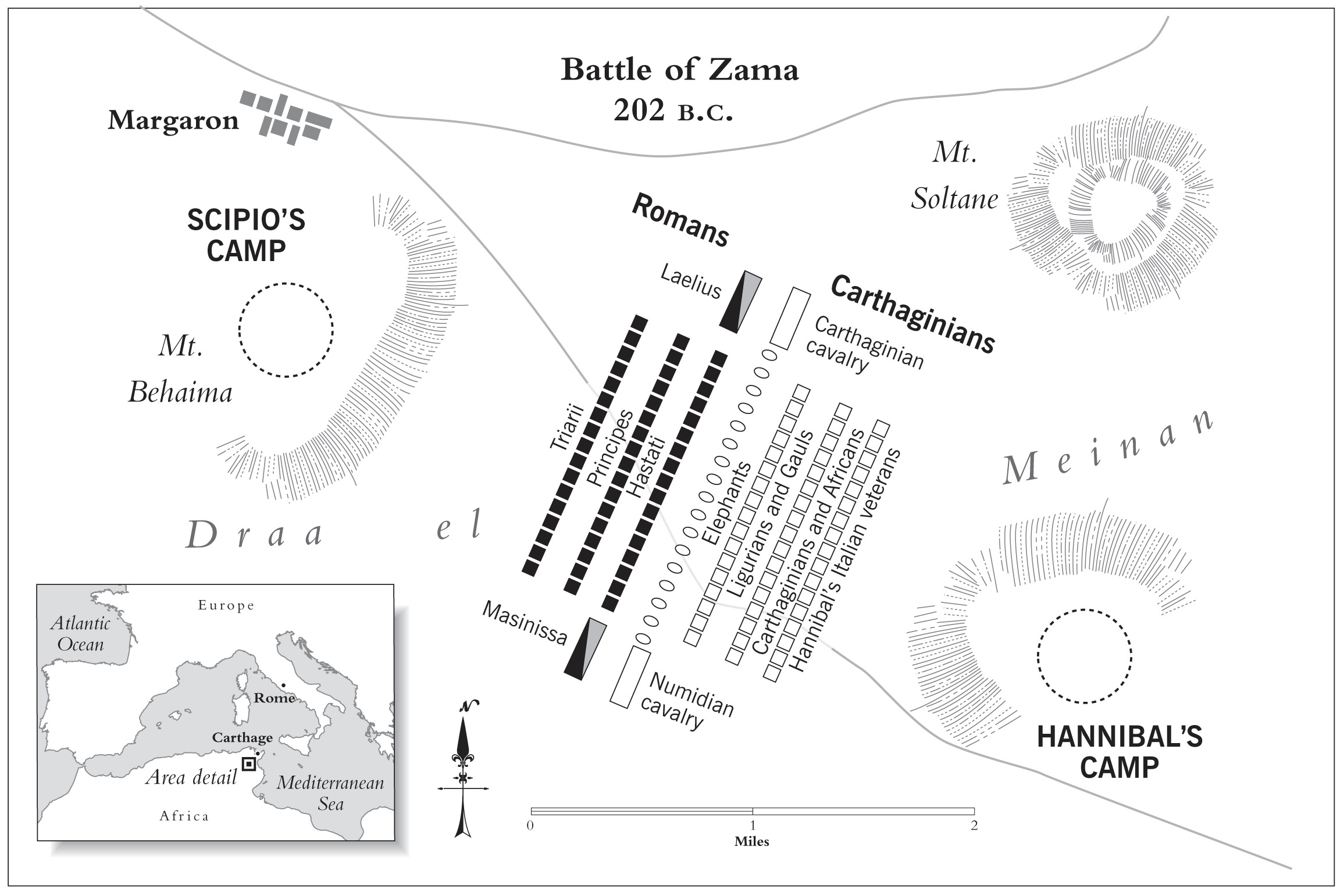
Hannibal opened with an elephant charge that Scipio neutralized by ordering his infantry to open lanes, letting the elephants pass through harmlessly.
When the cavalry battle was won on the flanks, Masinissa’s horsemen wheeled into the rear of the Carthaginian infantry, the same maneuver Maharbal had executed at Cannae, turned now against its inventor.
Hannibal lost.
He escaped the battlefield, one of the few Carthaginian commanders to survive, and returned to Carthage to advise the Senate to accept whatever terms Scipio offered.
The terms were severe.
Carthage surrendered its war elephants and its fleet, all but ten triremes.
It paid an indemnity of 10,000 talents, payable over fifty years.
Carthage’s annual state revenue (before the war) was roughly 1,200–2,000 talents.
So the annual indemnity payment of 200 talents represented 10–15% of their entire pre-war government income, every single year for 50 years.
Rome’s own annual revenue at the time was only about 5,000–7,000 talents.
One Roman/Attic talent weighed approximately 26 kg of silver.
Modern economic historians convert this using purchasing power (what it could actually buy in terms of grain, labor, soldiers’ wages, etc.), not just raw silver spot price.
Accepted range (2026 dollars):
1 talent = $550,000 – $750,000 USD in modern purchasing power
Total indemnity (50 years) at 10,000 talents: $5.5 billion – $7.5 billion
A single talent could pay the annual wages of roughly 200–250 Roman legionaries.
It could buy enough wheat to feed several thousand people for a full year.
It was forbidden from waging war outside Africa, and could not wage war within Africa without Rome’s permission.
The western Mediterranean was Rome’s.
INTERBELLUM: The Peace that wasn’t…
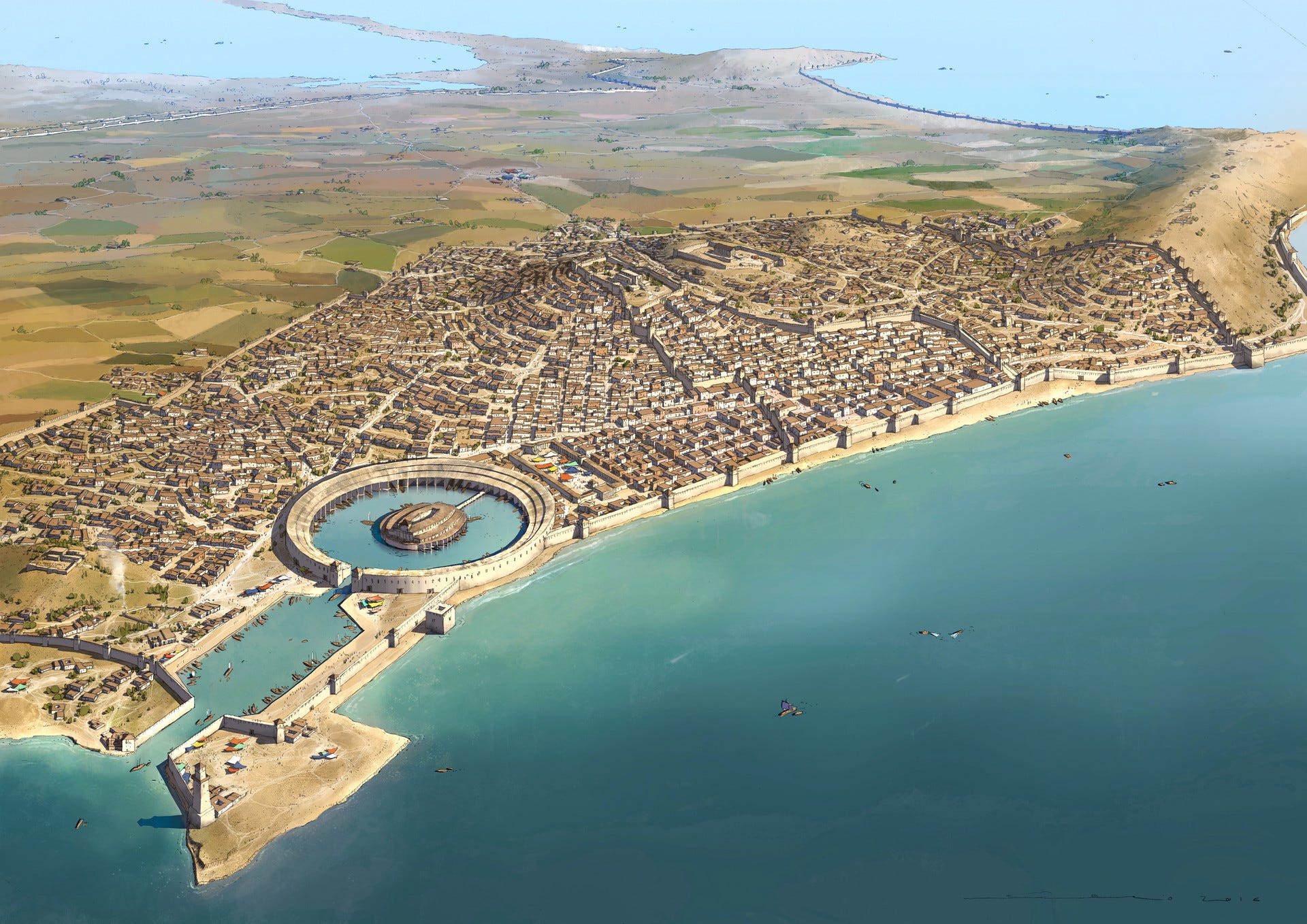
The terms Scipio imposed at Zama were designed to end Carthage as a strategic actor.
Hannibal accepted these terms because the alternative was the physical destruction of Carthage.
For the architects of the peace, the logic was clean.
Strip the weapons, take the money, install a watchdog.
The watchdog was Masinissa, king of Numidia, Rome’s loyal ally, whose cavalry had won Zama for Scipio and whose kingdom now bordered Carthaginian territory on every landward side.
If Carthage rebuilt, Masinissa would see it.
If Carthage threatened, Masinissa would report it.
If Carthage moved, Rome would know.
The architects were not wrong about the mechanism.
They were wrong about what they were containing.
After Zama, the man who had terrorized Italy for sixteen years did something Rome never anticipated, he turned inward.
Elected suffete in 196 BC, he attacked Carthage’s problems with the same systematic brilliance he had brought to Rome’s legions.
He rooted out corruption in the tax system, restructured the debt payments to Rome, and made Carthage solvent again.
The city’s finances were catastrophic, not because the indemnity was unpayable, but because the oligarchic Council of One Hundred and Four, the merchant families who had starved him of reinforcements in Italy, had been skimming revenue for decades.
Tax collection was corrupt.
Public funds vanished into private estates.
The indemnity payments that should have been manageable were crushing the population because the money was being stolen before it reached the treasury.
Hannibal dismantled the system.
He audited the tax rolls.
He restructured collection so that revenue flowed directly to the state rather than through the hands of magistrates with financial interests in its disappearance.
He made the annual indemnity payable from current revenue without extraordinary levies on the citizenry.
Livy records that he achieved this without raising a single new tax, the existing revenue was simply sufficient once the corruption was removed.
The results alarmed Rome more than any army could have.
In 191 BC, barely ten years into a fifty-year payment schedule, Carthage offered to pay the entire remaining indemnity in a single lump sum.
Consider what that offer meant.
A city that had lost a world war, surrendered its fleet, given up its war elephants, ceded Spain and its silver mines, and been saddled with a generation of debt was now so financially healthy that it could write a check for the full balance decades ahead of schedule.
The Roman Senate refused.
Livy and Appian both record the refusal, though they differ on the Senate’s reasoning.
The surface explanation was procedural, the terms specified fifty years, and Rome would hold to the terms.
The structural explanation was strategic.
The indemnity was not merely a payment.
It was a leash.
A Carthage still making annual payments was a Carthage that had to maintain relations with Rome, that had to appear before Roman magistrates, that had to perform submission on a schedule.
A Carthage that paid in full was a Carthage that owed Rome nothing.
The Senate understood, even if it never said so explicitly, that the debt was more valuable as leverage than as money.
Carthage kept paying.
And kept getting richer.
The archaeological record tells the story the ancient historians understood but could not quantify.
Excavations in the Carthaginian hinterland of the Bagradas River valley, the Cap Bon peninsula, the fertile coastal plains of what is now northern Tunisia; reveal an agricultural revolution in the decades after Zama.
Carthage had always farmed, but the loss of Spain and its mineral wealth forced a strategic pivot.
What had been a mercantile empire running on silver and trade became an agrarian powerhouse running on grain, olive oil, and wine.
The scale was enormous.
It was the only Carthaginian text Rome preserved.
Everything else, the histories, the navigational records, the philosophical works, was either burned or distributed to Numidian client kings.
But the farming manual survived because Rome needed it.
The methods it described, intensive cultivation of olives and vines, soil management techniques, estate organization, livestock integration; were producing yields that North Africa would not match again until the modern era.
Amphora evidence, the shattered pottery that is archaeology’s most reliable trade indicator, shows Carthaginian agricultural exports flowing across the western Mediterranean throughout the interbellum.
The trade networks the treaty was supposed to sever had simply reorganized.
Carthage could not project military power, but it could project economic power, and it did so with a sophistication that made Roman landowners nervous for reasons that had nothing to do with national security.
When Marcus Porcius Cato visited Carthage in 153 BC as part of a diplomatic mission to arbitrate yet another border dispute between Carthage and Masinissa, what he saw was not a broken city performing compliance.
He saw a wealthy, ordered, architecturally impressive metropolis that had rebuilt itself from the inside out.
Plutarch records that Cato brought fresh figs back to the Senate, held them up, and asked the senators to note how fresh they were.
Carthage, he told them, was only three days’ sail from Rome.
The figs were the evidence.
A city that could deliver fresh produce to the Roman Senate floor was not a distant, abstract threat.
It was a neighbor.
But the figs were theater.
What actually alarmed Cato, and what the archaeological record confirms he had reason to fear, was the harbor.
The Carthaginian cothon, the circular military harbor, separate from the rectangular commercial port, is one of the most extensively excavated naval installations of the ancient world.
The treaty permitted ten triremes.
The harbor could house 170 warships.
The physical infrastructure of naval power had not been dismantled.
It had been maintained.
Whether ships actually occupied those sheds during the interbellum is a question the archaeology cannot definitively answer.
Wood rots, and the harbor was extensively modified during the final siege and then demolished by the Romans after 146 BC.
But the sheds themselves were maintained in functional condition.
The stonework was kept in repair.
The slipways remained operational.
A city that was spending money maintaining 170 warship berths while operating a ten-ship navy was either preserving a historical monument or preserving an option.
The economic machinery tells the final part of the story.
Polybius, who was present at the destruction and had access to Carthaginian records that no longer survive, noted that Carthage’s annual revenue in the interbellum period was substantial.
The city was among the wealthiest in the Mediterranean.
The agricultural exports, the residual trade networks, the artisan manufacturing (Carthaginian purple dye remained a luxury commodity throughout the period), and the simple geographic advantage of controlling the finest natural harbor in the western Mediterranean meant that Carthage generated wealth faster than the indemnity could drain it.
Royal Purple, you may have heard of it and wondered about the association.
It came from the secretions of snails that the Phoenicians/Carthaginians monopolized the knowledge of production and supply for 1,500 years.
It was more valuable than gold.
You can buy some today from artisans at the Imperious cost of thousands of dollars per gram.
Rome had designed a peace that bled Carthage slowly.
Carthage healed faster than it bled.
Hannibal had seen all of this before his exile.
He had set the financial reforms in motion, knowing he would not be there to see their maturity.
When the merchant oligarchs conspired with Rome to force him out in 195 BC, barely six years after Zama, the systems he had built continued to function without him.
The revenue flowed.
The treasury filled.
The indemnity was paid on schedule.
And somewhere, in workshops and armories that did not appear in the reports Carthage filed with Roman magistrates, the sets of armor accumulated, the catapults were assembled, and the option that the harbor represented was kept warm.
None of this was irrational.
A state that has been defeated, disarmed, and placed under permanent surveillance by a power that has demonstrated willingness to destroy it does not calculate its future on the assumption that compliance guarantees survival.
It calculates its future on the assumption that the victor’s intentions are unknowable, and that the only insurance against annihilation is the quiet accumulation of the capacity to resist.
Carthage looked at the treaty and saw what every defeated power sees.
Not a guarantee of peace, but a schedule of vulnerability.
The terms did not make Carthage safe.
They made Carthage dependent on Rome’s continued goodwill, and Carthage had no reason to believe that goodwill was permanent.
Masinissa’s encroachments, consistently ratified by Roman arbitration, demonstrated year after year that Rome’s conception of the peace included the progressive territorial dismemberment of Carthage by proxy.
Every border dispute resolved in Numidia’s favor was a data point.
Every Roman arbitration commission that arrived, heard both sides, and ruled for Masinissa was a signal.
Carthage read the signals.
And Carthage armed.
The peace between the Second and Third Punic Wars lasted fifty-three years.
It was not a peace.
It was an arms race conducted by one party in secret and monitored by the other party with insufficient attention, against a backdrop of economic recovery so vigorous it should have been its own warning.
By the time Cato stood in the Senate with his figs, the question was no longer whether Carthage had rebuilt.
The question was whether Rome had waited too long to notice.
Hannibal The Old
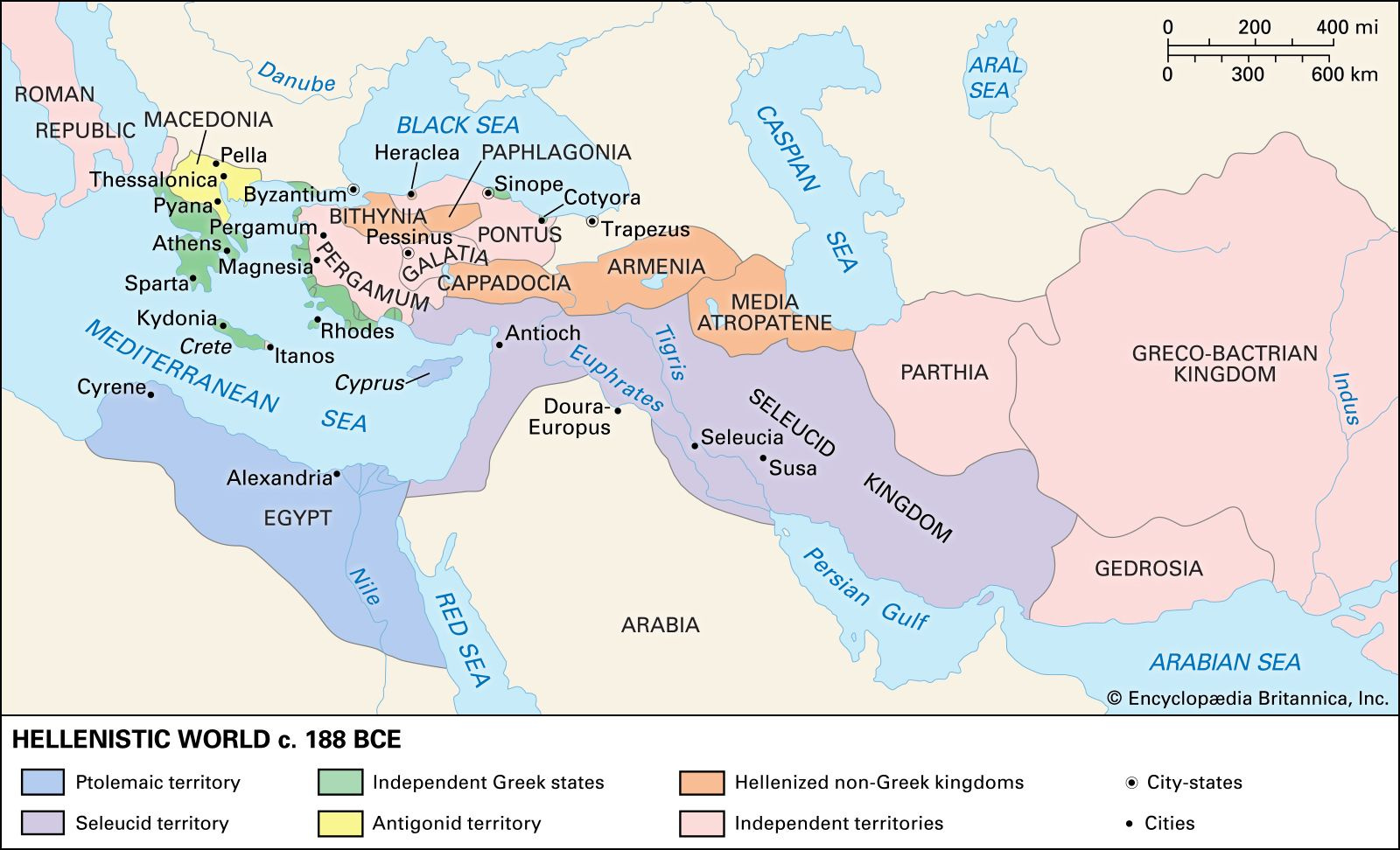
After the scheming of the merchant class, Hannibal fled to the Seleucid court of Antiochus III, then to Bithynia, spending his final years as a strategic advisor to kings who understood his value but could never give him the army he deserved.
Rome pursued him across the Mediterranean with the patient, implacable persistence that defined the Republic.
They could not forgive him for Trebia, for Trasimene, for Cannae.
They could not forgive him for making them afraid.
In approximately 183 BC, Roman envoys arrived in Bithynia demanding Hannibal’s surrender.
Hannibal, then in his mid-sixties, discovered that the king’s soldiers had surrounded his residence, blocking every exit.
He had prepared for this moment.
He carried poison in his ring.
According to Livy, his last words were: “Let us now put an end to the great anxiety of the Romans, who have thought it too lengthy and too heavy a task to wait for the death of a hated old man.”
He drank the poison and died.
Rome had not killed him on any battlefield.
Rome had simply made the world too small for him to live in.
X. The Third Punic War - Carthago Delenda Est
Carthage survived as a diminished, compliant state, faithful to the terms that Scipio had imposed.
It paid its indemnity.
It asked Rome’s permission before defending itself.
It did everything that was asked of it.
It was not enough.
Marcus Porcius Cato, Cato the Elder, the moral scold of the Roman Senate; visited Carthage in 153 BC as part of a diplomatic mission.
What he saw alarmed him: a wealthy, orderly city recovering from its defeat.
And figs. So many figs!
He returned to Rome and began ending every speech he delivered in the Senate, regardless of topic, with the same six words.
“Ceterum censeo Carthaginem esse delendam.”
Furthermore, I consider that Carthage must be destroyed.
Every speech.
On agriculture policy.
On road building.
On temple funding.
Carthage must be destroyed.
The repetition was performative and relentless and effective.
It lodged in the Roman political consciousness like a splinter.
Publius Cornelius Scipio Nasica, son-in-law of Scipio Africanus, the man who had defeated Hannibal at Zama, opposed Cato publicly.
He argued that Carthage, weakened and compliant, served Rome’s interests as a manageable rival whose existence kept the Roman people disciplined.
Destroy Carthage, he warned, and Rome would lose the external threat that held its own internal divisions in check.
His argument was sophisticated, strategic, and ultimately ignored.
In 149 BC, Rome found its pretext.
Carthage had defended itself against a Numidian incursion, an act that technically violated the treaty, which required Roman permission for any military action in Africa.
The violation was real.
The provocation, however, had been engineered: Rome’s Numidian ally Masinissa had been encroaching on Carthaginian territory for years.
Rome had consistently ruled in his favor in every dispute, leaving Carthage in the impossible position of choosing between territorial dismemberment and treaty violation.
Rome dispatched an army.
The initial Roman demand was the surrender of weapons and hostages.
Carthage complied.
Rome issued its final ultimatum in 149 BC, demanding that Carthage surrender all arms before revealing the additional demand to abandon the city.
Appian records that the Carthaginians complied with the weapons demand completely and immediately.
What they handed over staggers: two hundred thousand complete sets of armor and two thousand catapults.
Two hundred thousand sets of armor.
In a city whose treaty forbade independent military action.
In a state that had not fought a war, officially, in fifty years.
That was enough armor to equip the ENTIRE population of Carthage.
All the people within, not just the military aged men.
The number is sometimes questioned by modern historians as potential exaggeration by Appian, but even discounted by half, even discounted by two-thirds, the implication is the same.
The catapults are particularly telling.
These are not dual-use agricultural implements.
A catapult has exactly one purpose.
Two thousand of them represent a deliberate, sustained, and expensive program of rearmament that someone authorized, someone funded, and someone kept hidden from Roman inspectors for a generation.
Carthage had been manufacturing and stockpiling military equipment on an industrial scale, quietly, over decades, while performing every outward gesture of compliance with the treaty terms.
The Romans then demanded that the Carthaginians abandon their city entirely and relocate at least ten miles inland, away from the sea.
For a people whose identity was the sea, whose wealth was the harbor, whose gods lived in the temples on the Byrsa hill, this was not a demand for relocation.
It was a demand for civilizational suicide.
Carthage refused.
For the first time in fifty years, they chose war.
The Third Punic War lasted three years.
It was not, in any meaningful sense, a war.
It was a siege.
The army Carthage fielded against Masinissa in 150 BC, the act that technically violated the treaty and gave Rome its pretext, numbered between twenty-five and fifty thousand men, depending on the source.
It was ultimately defeated by Masinissa at the Battle of Oroscopa.
They were no match without someone of Hannibal’s caliber, long dead now.
Carthage was a trade state. Their army was composed of mostly civilian levies and mercenaries.
Not a continuously warring state like Rome.
Rome was always prepared for war.
The doors of the Temple of Janus (which were kept open during war and closed only during peace) were closed only three times in over 700 years of Roman history:
During the reign of Numa Pompilius (legendary, ~700 BC)
In 235 BC (after the First Punic War)
In 29 BC (by Augustus after the Battle of Actium)
Carthage, disarmed, outnumbered, without allies, without a fleet, without Hannibal, held its walls against the most powerful military machine on Earth for three years through sheer desperation.
Ancient sources record that when weapons ran out, Carthaginian women cut their hair to braid into bowstrings.
In 146 BC, the walls were breached.
The commander of the Roman assault was Scipio Aemilianus, adoptive grandson of Scipio Africanus, the man who had been merciful at Zama.
Aemilianus was not merciful.
The city was taken street by street over six days of fighting.
Prisoners were not taken during the assault.
When organized resistance ended, the surviving population, perhaps 50,000 people, was sold into slavery.
Polybius was present, standing beside Scipio Aemilianus as the city burned.
He records that Scipio wept.
And then Scipio turned to Polybius and quoted Homer, lines from the fall of Troy.
“A day will come when sacred Troy shall perish, and Priam and his people shall be slain.”
When Polybius asked what he meant, Scipio said he feared that someday the same fate would befall Rome.
The city burned for seventeen days.
Subsequent Roman sources claim that the ruins were sown with salt so that nothing would ever grow there again.
Carthage was erased.
Not conquered, not subjugated, not incorporated.
The physical city was demolished.
The population was dispersed into slavery.
The territory became the Roman province of Africa.
The name Carthage became, in Roman rhetoric, a synonym for the fate of those who defied Rome and a warning to those who might consider it.
The victory over Carthage gave Rome unrivaled wealth, through provinces and tribute; along with total military dominance without naval rivals and secure supply lines.
Africa supplied Rome with huge amounts of grain (later feeding up to 1/3 of Rome’s population), olive oil, and other goods; a constant stream of wealth for centuries.
Without defeating Carthage, Rome would never have become the Mediterranean superpower we remember.
Many ancient and modern historians consider the destruction of Carthage the turning point that made Rome a true empire.
The Greek historian Polybius wrote that after Carthage fell, “the Romans had become the masters of the world.”
XI. What Maharbal Knew
The debate over Hannibal’s decision at Cannae has never ended because it contains a question that has no clean answer: when you have won the battle but not the war, and the window for converting one into the other is measured in days, what do you do?
Maharbal’s argument was simple.
March now.
The enemy is broken.
His army is dead.
His capital is undefended.
Five days.
Finish it.
The argument has the clean, brutal clarity of a cavalry commander.
A man whose profession was the exploitation of fleeting advantage, the conversion of disorder into rout, rout into annihilation.
Hannibal’s hesitation was that of a strategist who understood something Maharbal did not, or did not weigh heavily enough: the difference between taking a city and holding a world.
Rome was not Carthage.
It was not a single city whose fall ended the war.
It was a network.
A confederation of hundreds of communities bound by treaty, self-interest, fear, and genuine loyalty.
Taking Rome might not collapse that network.
It might harden it.
And if Hannibal sat inside Roman walls with an exhausted army of 40,000 while 300,000 Roman allies converged on his position, Cannae’s roles would reverse.
Both men were right.
Both men were wrong.
Maharbal was right that the moment would never come again and it never did.
Hannibal was right that the strategic problem could not be solved by a single dramatic stroke.
The tragedy is that between them they had identified the precise contours of their predicament and found no exit from it.
What Cannae proved, and what the sixteen years of war that followed confirmed, was something that neither tactical brilliance nor strategic patience could overcome: the side that can absorb punishment and regenerate will always outlast the side that must win quickly or not at all.
Rome lost 80,000 men in an afternoon and raised more legions before the next harvest.
Carthage could not replace a single cohort in Hannibal’s army without a supply chain it never built and a political will it never summoned.
Hannibal won every battle and lost the war.
Rome lost every battle and won the world.
And then, because Rome’s institutional memory was longer than any individual life and its capacity for vengeance was bottomless, Rome returned fifty years later to ensure that the people who had produced Hannibal could never produce another.
Scipio wept at the burning because he understood the lesson.
Empires that destroy what they cannot control do not become safer.
They become the kind of power that must destroy everything.
They have demonstrated to the world that survival under their dominion is not guaranteed, and therefore resistance, however futile, becomes rational.
Maharbal was right.
Hannibal should have marched.
But Rome would have burned Carthage regardless.
1.0 Opportunity Wasted
“Men ought either to be well treated or crushed,
because they can avenge themselves of lighter injuries,
of more serious ones they cannot;
therefore the injury that is to be done to a man,
ought to be of such a kind that one does not stand in fear of revenge.”
Niccolò Machiavelli, The Prince, Chapter 3 (1532)
The story of Hannibal, the Great and Terrible, is a thrilling ride of intellectual brilliance, courage, and luck.
The world obsesses over the myth of the Great Man.
He Who Overcomes.
But victory in small and large measure require both the assistance of others and a heaping dose of luck.
What is bold may work one day and not the next.
The Punic Wars, all 3 of them, are also a great study of Escalation Dynamics.
The fluidic nature of domination, maneuvering, and biding one’s time.
2025-06-22 Operation Midnight Hammer
This was the Cannae victory moment for US-Israeli forces.
They looked unstoppable.
And then they allowed Iran to rebuild.
“Allowed” might be too strong of a word.
Iran was a formidable opponent, unleashing a taste of its arsenal for the first time.
It was a reasonable end to hostilities for all parties.
Everybody got to look tough and then call it off like adults.
2026-02-27 Operation Epic Fury
The interbellum was the rebuild phase enabled by leniency.
Machiavelli laughs at half measures.
No mercy and magnanimity should be shown to your enemies.
Absolute, crushing force should have been deployed against Iran.
Or Iran in turn, should have shown no mercy to the reeling Israelis.
Perhaps, the conflict have ended bloodily at Midnight Hammer.
But now we face the same inevitable bloodiness 8 months later.
Months ago, all Belligerents were facing their own Hannibal moment of hesitation.
They stared at Rome’s walls.
Unsure of what to do next.
For good reasons, if looked at impartially.
2.0 Resolution
Perhaps impossible at this stage of the conflict.
The Middle East will never be in balance.
Israel possessing nuclear capability guarantees that.
And their justifiable paranoia will never allow them to voluntarily disarm.
No matter what the outcome, we predict Iran will deploy the Carthage model.
They are going to build in secret and become nuclear capable.
It’s the logical game theory optimal move.
We publish this as a warning for all parties.
The final scoreboard for Epic Fury is not known to us at this time.
And score doesn’t matter because…
Whatever resolution, treaty or ceasefire terms are discussed; the system dynamics have shifted.
The end result of Epic Fury will not be peace.
It will be the silent escalation of military buildup unless Machiavelli is heeded.
Total War.
Total Annihilation.
Not an endorsement. But a necessity dictated by game theory.
Diplomacy was possible pre-Epic Fury.
But there is too much bad blood now.
Or perhaps the Reader thinks the bad blood can somehow be set aside.
3.0 Sneakout
Enrichment from 0.7% natural uranium to 3.67-5% LEU requires the overwhelming majority of the total separative work.
In the enrichment physics framework from the historical primer, getting from natural to 5% is roughly 70% of the SWU needed to reach weapons grade.
The reason is mass balance, you’re starting with an ocean of U-238 and trying to concentrate a tiny fraction of U-235.
You need to process enormous volumes of uranium hexafluoride (UF6) feed to extract a meaningful quantity of product.
That’s why Natanz had halls containing thousands of centrifuges.
It has a physical footprint that is detectable from satellite imagery; the building itself, the electrical substation, the cooling units, the security perimeter.
Iran doesn’t need to do it at industrial scale in a single facility.
They could distribute.
Perhaps Epic Fury succeeds. Iran must handover its current stockpiles.
But they rebuild in secret like Carthage.
Say instead of one facility with 3,000 centrifuges, you build 30 facilities with 100 centrifuges each.
Or 60 facilities with 50 each.
Each individual facility is dramatically smaller.
A cascade of 50-100 centrifuges fits in a large basement.
The power draw is equivalent to a small commercial building.
The cooling requirements are modest.
The UF6 handling equipment scales down.
The tradeoff is time.
100 IR-1 centrifuges produce about 100 SWU per year.
To accumulate enough LEU feedstock for one bomb’s worth of eventual HEU, that single small cascade needs roughly 30-50 years.
Obviously useless as a single unit.
But 30 such cascades operating in parallel get you there in 1-2 years.
And 60 get you there in under a year.
Each individual facility is small enough to plausibly disguise as a commercial or industrial building.
The electrical draw maybe equivalent to a small factory, a data center, a hospital wing.
Nothing that would flag on satellite thermal analysis.
The building could be 20x30 meters.
Ordinary looking from above.
No distinctive cooling towers or security perimeters that scream “nuclear facility.”
The entire nonproliferation monitoring architecture is optimized for finding LARGE facilities.
Satellite imagery looks for distinctive building shapes, security perimeters, electrical substations, and patterns consistent with known enrichment facility designs.
The IAEA declaration regime requires states to declare facilities above certain thresholds.
Intelligence agencies monitor procurement networks for bulk purchases of centrifuge components.
A distributed network of small cascades defeats most of these detection methods.
No single facility looks unusual from overhead.
Power consumption doesn’t flag.
Each small facility needs fewer components, purchased in smaller quantities that are harder to track in procurement databases.
Construction looks like ordinary commercial or industrial building work.
3.1 So why hasn’t Iran done this?
Several reasons, but none of them are permanently binding.
First, UF6 feed production is the chokepoint. You can distribute centrifuge cascades, but you still need UF6 feed, and producing that feed at scale is harder to hide.
However Iran has already produced and stockpiled thousands of kilograms of UF6 at various enrichment levels.
If Iran has pre-produced the UF6 feed, it doesn’t need to run the conversion facility concurrently with the distributed enrichment.
It can produce the feed at known facilities, stockpile it, and then distribute it to hidden cascades over time using ordinary trucks.
Second, centrifuge manufacturing is trackable.
Building centrifuges requires specialized components.
Iran manufactures these domestically now, but the manufacturing facilities are known and monitored.
Procuring or manufacturing components for 3,000 distributed centrifuges creates a supply chain that intelligence agencies try to track.
But Iran has been manufacturing centrifuge components for over two decades.
They have institutional knowledge, domestic supply chains, and presumably have stockpiled components and spare parts.
After Midnight Hammer, the imperative to stockpile and distribute would be overwhelming.
And if they didn’t do it after Midnight Hammer, the incentive becomes near certain no matter the result of Epic Fury.
Every Iranian nuclear engineer has just seen their known facilities destroyed.
The lesson is blindingly obvious: don’t concentrate.
Third, and this is the political reason: Iran historically WANTED its enrichment program to be visible.
The entire strategy as a bargaining chip only works if the adversary can SEE what you’re doing.
A hidden program produces leverage only when it’s revealed, which defeats the purpose of hiding it.
Iran was playing a coercive diplomacy game that required demonstrated capability at known facilities.
That calculus changed after Midnight Hammer and Epic Fury.
Demonstrated capability at known facilities got those facilities bombed.
The lesson Iran learned in June 2025 is identical to the lesson any military planner learns from concentrated, visible assets being destroyed: disperse, harden, conceal.
If Iran is pursuing distributed enrichment, the military option degrades rapidly.
You cannot bomb 30 or 60 small facilities you haven’t identified.
The intelligence requirement shifts from “find the big building with the security perimeter” to “find the basement in Mashhad that has 50 centrifuges in it.”
That’s a fundamentally different intelligence problem and one that overhead surveillance is poorly suited to solve.
4.0 The Parallel Sprint
The standard breakout framing is misleading.
When you hear “Iran is X weeks/months from breakout,” that number typically refers to ONE step, enriching enough uranium from 60% to 90% weapons-grade.
As of early 2026, the IAEA estimated Iran could produce 25 kilograms of weapons-grade HEU (enough for one simple implosion device) in roughly 1-2 weeks from its current 60% stockpile.
Some estimates said days.
Then analysts append “but weaponization takes 1-2 years” as if that’s a sequential process that hasn’t started.
That framing assumes Iran is sitting around waiting to START designing bomb components only after it has the fissile material in hand.
That assumption is absurd.
4.1 Nuclear Fission Bomb Basics
If you had a chunk of uranium and a stick of dynamite and you had the brilliant idea of building a nuclear bomb, you would be very disappointed.
The resulting device would be a radioactive shrapnel bomb.
Dangerous, but not quite the mushroom cloud devastation you might have envisioned.
The process of building The Bomb is complicated.
Which is why the brightest minds humanity produced took years to solve the problem.
So let’s take a look at some basics first and what it means operationally for Iran’s sprint for weaponization.
4.2 Nuclear Fission Process
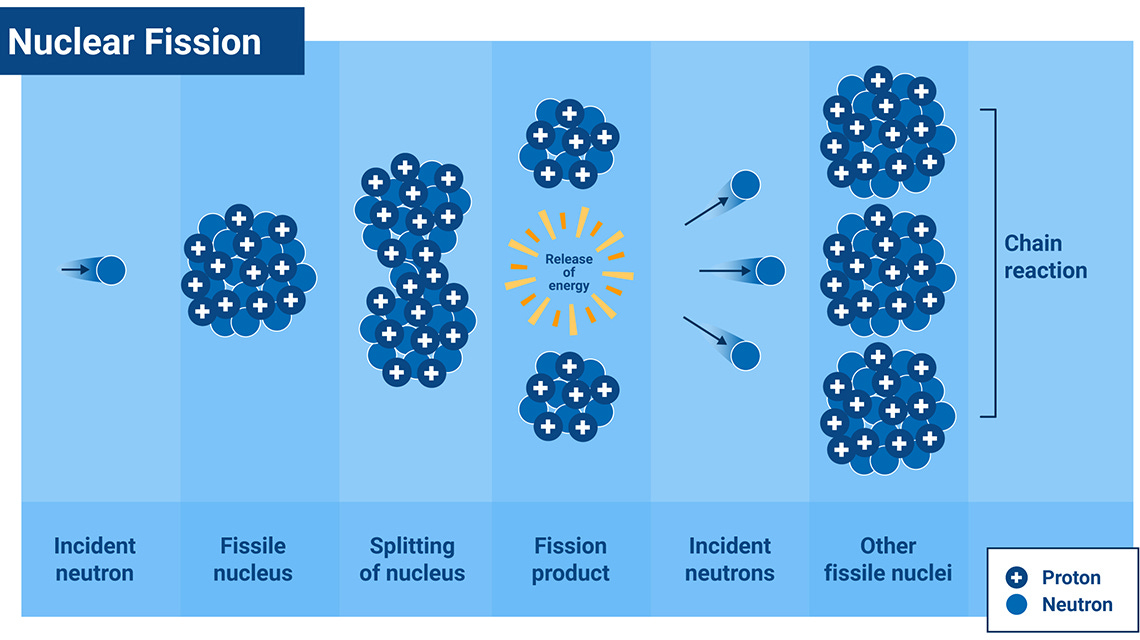
A nuclear bomb works by splitting atoms.
This is called nuclear fission.
Normal uranium has mostly U-238 atoms (which are stable).
Only a tiny amount (0.7%) is U-235 are these are the special atoms that can split.
In a bomb, scientists enrich the uranium so it’s 90%+ U-235.
What Happens When an Atom Splits
A neutron smashes into a U-235 atom.
The atom becomes unstable and splits into two smaller atoms (like Krypton and Barium).
When it splits, it releases:
A huge amount of energy (heat and light)
2 or 3 new neutrons
Chain Reaction Explosion
Those 2–3 new neutrons fly out and hit other U-235 atoms.
Those atoms split too, releasing even more neutrons.
In a fraction of a second, this turns into a runaway chain reaction of billions of atoms splitting at once.
This all happens so fast that the energy release is instantaneous and massive.
That’s the nuclear explosion.
Simple Analogy
Imagine a room full of mousetraps, each with a ping-pong ball on it.
You throw one ball in.
It sets off one trap.
That ball flies and sets off two more…those set off four more…
In a nuclear bomb, that chain reaction happens in millionths of a second with trillions of atoms.
That’s why one kilogram of U-235 in a bomb can release as much energy as 20,000 tons of TNT.
4.3 Components of a Basic Fission Bomb
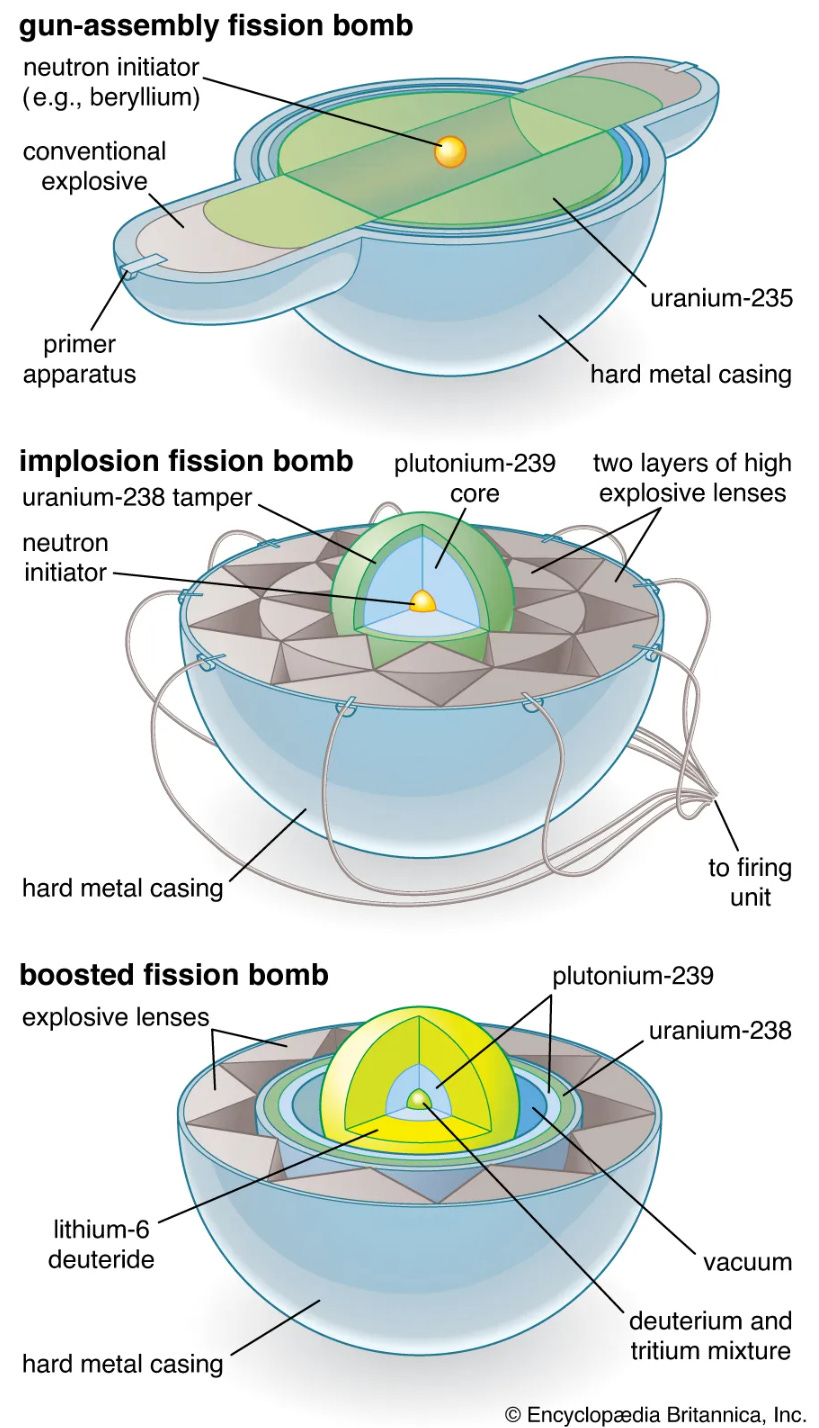
The fissile core, the pit, the actual weapons-grade uranium or plutonium shaped into the right geometry.
This is the ONLY component that requires enriched material.
Everything else doesn’t.
The conventional explosive lenses are precisely shaped charges that create the symmetrical implosion wave to compress the core to supercriticality.
The detonation system are electronic triggers that fire the explosive lenses with nanosecond precision.
The neutron initiator is the component that provides the initial burst of neutrons to start the chain reaction at the moment of maximum compression.
The tamper/reflector is typically natural uranium or beryllium surrounding the core that reflects neutrons back and provides inertial confinement.
And for a deliverable weapon: the reentry vehicle, the hardening against thermal and mechanical stress during ballistic flight, the arming and fuzing system.
Every single one of those components can be designed, built, tested, refined, and stockpiled WITHOUT a single gram of weapons-grade uranium.
You can test explosive lens geometry with inert cores.
You can test firing circuits with dummy pits.
You can machine tamper reflectors from natural uranium.
You can design and test reentry vehicles with conventional payloads.
You can do computational modeling of the full implosion physics using modern simulation tools without ever conducting a nuclear test.
4.4 The IAEA DID find evidence of this.
The Amad Program, Iran’s pre-2003 organized weapons development effort, worked on precisely these components.
IAEA inspectors found evidence of explosive lens testing, multipoint detonation system development, neutron initiator research, and reentry vehicle design for the Shahab-3 missile.
Iran officially “halted” the organized program in 2003 under international pressure.
But here’s the thing about knowledge and physical components: they don’t un-exist.
The scientists who designed explosive lenses didn’t forget how.
The engineering drawings for the reentry vehicle didn’t disappear.
The computational models didn’t get deleted.
And everything we know about Iranian strategic culture: the parallel institutions, the IRGC’s independent research capability, the deep underground facilities at Fordow and elsewhere; suggests that a country facing existential threats doesn’t abandon its most important military research because a program was officially “reorganized.”
The IAEA’s own assessment, maintained through multiple reports, was that Iran conducted “activities relevant to the development of a nuclear explosive device” and that it could not verify these activities had fully ceased.
The diplomatic language is careful.
The implication is not.
4.5 Logical Iranian Strategy
Think about it from Iran’s perspective.
You’ve been targeted for regime change by the regional nuclear hegemon and the global superpower.
You’ve watched Iraq get invaded, Libya get overthrown, Ukraine get invaded; all non-nuclear states.
You’ve watched North Korea and Pakistan remain untouched, both nuclear states.
The survival logic is absolute: you need a nuclear deterrent.
But you also know that the moment you enrich to 90%, every satellite, every intelligence service, every sensor is watching.
The enrichment facilities at Natanz and Fordow are monitored, inspected (when inspectors are allowed in), and targeted.
Enrichment is the VISIBLE step.
It’s the step that triggers military action.
So the optimal strategy is: do everything EXCEPT the visible step.
Build the explosive lenses.
Perfect the detonation system.
Machine the tamper.
Design the reentry vehicle.
Test everything with inert cores or computational simulation.
Store the components in hardened underground facilities.
Iran has been building deep tunnel complexes for decades, some reportedly 80+ meters underground in mountain geology that would require nuclear bunker-busters to reach.
Then the “breakout” isn’t enrichment plus 1-2 years of weaponization.
The breakout is enrichment plus ASSEMBLY.
And assembly, inserting a machined HEU pit into a pre-built physics package, is an absolute sprint.
This reframes the entire timeline.
The realistic framing if ancillaries are pre-built: deliverable assembled nuclear weapon in ONE TO THREE MONTHS from decision to enrich from 60% to 90% then assembly, not 1-2 years.
And if they’ve been running parallel enrichment in an undeclared facility, which is not paranoid speculation given that Fordow’s EXISTENCE was an undeclared facility that only came to light in 2009 through intelligence, the timeline could be even shorter because the enrichment step could happen outside IAEA monitoring.
It might be weeks if Iran already has the 90% HEU. Just assembly at that point.
This is exactly what Israel fears, and it’s exactly why the deal mattered.
The deal on the table, dilute the 60% stockpile, convert to irreversible fuel form, full IAEA verification; addressed the ENRICHMENT step.
It would have extended the timeline for producing weapons-grade material from weeks to many months or over a year.
That matters enormously even if the ancillaries are pre-built, because it gives detection and response time.
But it doesn’t address the ancillaries.
And Israel’s position is that the KNOWLEDGE and CAPABILITY to build ancillaries can’t be un-learned, so any deal that leaves Iran’s technical infrastructure intact is temporary.
It buys time but doesn’t solve the problem permanently.
4.6 Game Theory of Nuclear Escalation
And this is where Israel’s logic becomes self-defeating.
Because the strikes today DON’T DESTROY THE KNOWLEDGE EITHER.
You can bomb Natanz.
You can bomb Fordow (maybe…it’s deep).
You can bomb every declared nuclear facility.
You cannot bomb the knowledge out of the heads of thousands of Iranian nuclear physicists and engineers.
You cannot bomb computational models stored on air-gapped servers in mountain facilities you don’t know exist.
You cannot bomb explosive lens designs that were perfected 20 years ago and exist in multiple copies in multiple locations.
What the strikes DO accomplish is eliminating every Iranian incentive to NOT build the bomb.
Demand: Give up the path to weapons.
Offer: We guarantee your security and lift sanctions.
Iran agreed at the negotiation table per Omani mediator disclosures.
The strikes say: Even if you agree to give up the path, we’ll bomb you anyway.
The lesson is ABSOLUTE, only a completed weapon deters attack.
Every day of bombing reinforces the case for the faction within Iran’s leadership that has been arguing for weaponization.
And here’s the darkest possibility that nobody in mainstream analysis wants to discuss:
What if Iran already has a device?
Not deployed on a missile.
Not weaponized in the deliverable sense.
But a testable device, assembled from pre-built ancillaries and enough HEU diverted from declared or undeclared stocks over the past two years of reduced IAEA access.
Iran expelled specific experienced IAEA inspectors in 2023.
Monitoring cameras were offline for extended periods.
Iran has been enriching at 60%, which is 90% of the way to weapons-grade in terms of separative work, and accumulating stockpile far beyond any civilian justification.
The IAEA repeatedly reported it could not verify the completeness of Iran’s declarations.
There is no 100% confirmation that Iran has a device.
The confidence interval on “Iran doesn’t have a device” is wider than the mainstream analysis acknowledges.
The decision to launch regime change strikes against a country that MIGHT already have a nuclear capability is either the most reckless gamble in modern military history, or it’s based on intelligence so definitive that the US and Israel are certain Iran hasn’t crossed the threshold.
Given that US intelligence assessed Iraq had WMDs in 2003 with high confidence and was completely wrong, the track record on these assessments is not reassuring.
4.7 Institutional Validation of Distributed Enrichment and Parallel Sprint
The mainstream media and government planners are always late.
The intelligence community is not.
But nobody cares about what a bunch of nerds are writing in a dark room.
Too boring.
Too technical.
Too long.
The CIA Research Team, yours truly on this Substack, using First Principles wargaming derived the endpoint of game theory escalation logic.
We came to the above conclusions independent of the below corroborating datapoints.
4.7.1 Distributed Enrichment
The hypothesis that Iran can use its advanced centrifuges in small, 50-to-100 machine clusters hidden in standard buildings is the exact operational nightmare currently being debated by the Washington Institute and the Institute for Science and International Security (ISIS).
4.7.1.1 The Washington Institute for Near East Policy - Post-Midnight Hammer Assessment
They concluded the primary threat going forward is that Iran would abandon large footprints and “create small, dispersed, redundant facilities.”
They acknowledged that overhead US satellite intelligence is effectively useless against this.
4.7.1.2 The Advanced Centrifuge Multiplier - ISIS Reports
David Albright’s nuclear think-tank (ISIS) mapped out the math of the IR-6 centrifuge.
They warned that the timeline for breakout using a small, clandestine network has effectively shrunk to a matter of weeks, noting that an IR-6 network leaves almost zero thermodynamic or visual signature from space.
4.7.2 Parallel Sprint
4.7.2.1 The Iran Watch / Dr. Bruce Goodwin Assessment
An expert on nuclear weapon design at the Wisconsin Project recently warned of exactly this.
Because of the Amad Atomic Archive stolen by Israel in 2018, we know Iran already perfected the multi-point detonation system, neutron initiators, and high-voltage firing equipment decades ago.
Goodwin pointed out that building these ancillaries today “hides in plain sight” inside Iran’s massive conventional munitions factories, completely invisible to IAEA inspectors.
4.7.2.2 ODNI Intelligence Shift - FDD Panic
In early 2024, the Office of the Director of National Intelligence (ODNI) routinely stated in its reports: “Iran is not currently undertaking the key nuclear weapons-development activities.”
By late 2024 and into 2025, that phrase was entirely deleted from US intelligence assessments.
Intelligence agencies strongly suspect the “parallel sprint” is already in motion.
4.7.2.3 European Leadership Network Feb 2026
A recent ELN brief explicitly warned that intelligence indicates “parallel progress in weaponisation-related activities, significantly shortening Iran’s breakout timeline.”
4.7.3 The Facility Math
Here are the precise engineering and thermodynamic metrics confirming the “Retail Bakery” footprint, derived from models by Dr. Alexander Glaser (Princeton / Science & Global Security), David Albright (Institute for Science and International Security - ISIS), and the Federation of American Scientists.
4.7.3.1 Spatial Mathematics of the 150 Square Meter Nightmare
The public imagines enrichment requiring the vast, multi-acre underground halls of Natanz.
But Natanz was designed in the 2000s for tens of thousands of primitive, clunky, inefficient IR-1 centrifuges.
We are not in the IR-1 era.
We are in the IR-6 era.
“The enrichment output of the IR-6 centrifuge when operating in a production-scale cascade is estimated… at 5.25 SWU per year per centrifuge.”
IR-1 average in cascade: 0.6–1.0 SWU/year (ISIS and IAEA data).
IR-6 improvement: 5.25 / [ 0.6 - 1.0 ] = 5.25x to 8.75x
Iran doesn’t need to do the heavy lifting from 0.7% natural uranium.
They already possess massive stockpiles of 60% Highly Enriched Uranium (HEU).
Because the thermodynamic work is done, David Albright’s institute calculated that a clandestine site would require as few as 650 IR-6 machines to convert 60% stock to 90% weapons-grade in just one month.
If they only wanted to build a smaller cascade to squeeze out one bomb over a slightly longer period (or if starting from higher enrichment), they could use just 2 to 3 cascades (roughly 150 to 300 machines).
Source: Alexander Glaser (Princeton) – “Characteristics of the Gas Centrifuge for Uranium Enrichment” Science & Global Security, 2008
Declassified models of the Iranian pipeline design prove that a single centrifuge requires approximately 1 square meter (10.7 square feet) of physical floor space for the machine, the cascade piping, and the walkway.
A 150-machine final-stage enrichment cascade fits neatly into 150 square meters (approx. 1,600 square feet).
That is the size of a standard mid-size retail space, a suburban basement, or a small auto-body shop.
You cannot locate a 1,600 sq ft room from a satellite when there are millions of identical industrial rooms spread across a country of 88 million people.
4.7.3.2 Stealth Power Consumption
The most common way U.S. intelligence hunted old nuclear facilities was by looking for massive electrical power draws.
Gaseous diffusion plants used literally hundreds of megawatts, enough to dim the lights of a nearby city.
A modern gas centrifuge entirely bypasses this detection method.
Inside the centrifuge casing, the rotor spins in a near-perfect vacuum to eliminate air drag.
Because there is virtually zero friction, a centrifuge operates much like a spinning top floating on a magnetic bearing.
While a machine takes a surge of power to spool up, maintaining the supersonic spin requires an absurdly low steady-state electrical draw, often estimated around 50 to 150 Watts per machine.
If a clandestine cascade consists of 200 machines running at 100 Watts each, the entire nuclear apparatus only draws 20 Kilowatts (kW).
Add another 10 to 15 kW for vacuum pumps, cascade feed withdrawal systems, and basic facility lighting, and your total grid pull is roughly 30 to 40 kW.
40 kW is the electrical equivalent of running three heavy-duty commercial baking ovens, or a standard centralized HVAC system for an office building.
It does not create an anomaly on the municipal power grid.
You could tap it directly off a standard light-industrial power line without local utility companies even noticing.
4.7.3.3 Masking the Thermal and Chemical Traces
When Israel bombed Iraq’s Osirak (1981) and Syria’s Al Kibar (2007), they bombed plutonium reactors.
Reactors are physically impossible to hide because they run unbelievably hot; you need a massive, continuous river of cooling water, which creates a huge, verifiable thermal plume from space.
Centrifuge cascades do not split atoms; they just mechanically spin gas.
They produce almost no thermal radiation.
An ordinary commercial air-conditioning unit sitting on the roof completely neutralizes whatever nominal heat the vacuum pumps generate.
The working gas is Uranium Hexafluoride (UF6).
If leaked, it is highly reactive and forms hydrofluoric acid.
Zero trace gas escapes into the atmosphere for IAEA “sniffer” environmental tests to detect.
4.8 Institutionally and Engineering Verified
Organizations like ISIS or the IAEA publish dense, 80-page technical PDFs full of academic jargon (”safeguard divergence,” “SWU equivalent thresholds”) that average investors and political junkies never read.
Meanwhile, CNN and the NYT just report: “US says Iran is 12 months away from a bomb.”
The entire U.S. and Israeli counter-proliferation doctrine assumes the enemy is hiding a mountain.
But the physics of the IR-6 centrifuge dictate that the enemy is only hiding a 1,600-square-foot room.
If Iran shifted its pre-processed uranium to three anonymous industrial basements scattered across the sprawling urban sprawl of Tehran, they could quietly assemble a weapon in weeks.
A B-2 Spirit bomber carrying a 30,000-pound bunker buster is completely useless if the intelligence apparatus is looking for an underground fortress, but the physics package is quietly coming to life next door to a bakery.
5.0 Tick Tock
If the Islamic Regime survives, they will almost certainly be pursuing exactly what is described.
US-Israeli forces are playing a dangerous game.
We all went to sleep with what the world will recall as a very conciliatory position from Iran.
Then the strikes by US-Israel forces.
Then the Trump speech that declared regime change, and threatened annihilation.
Iran will become the worst enemy US-Israeli forces have ever had to deal with.
Diplomacy is no longer an option.
Iran must be obliterated.
Persia delenda est.
Or they will survive and will be working on those nuclear tipped ICBMs that don’t exist YET after whatever treaty is signed.
They’ve learned their lesson.
And they may have already put that lesson to good use.
The mainstream narrative: Iran is years from a bomb, we have time, strikes set the program back.
If the ancillaries were pre-built and hidden, which is the rational strategy for a nation under existential threat, the “weaponization timeline” that everyone cites as breathing room may not exist.
Days? Weeks? Months?
The Midnight Hammer strikes may have eliminated declared facilities while leaving the actual weapons capability intact in hardened undeclared underground sites.
And the Epic Fury strikes have now pushed Iran to pursue a completed weapon with absolute urgency, because Epic Fury is proving in real time that the only thing that would have prevented this attack is a nuclear deterrent.
Ayatollah Ali Khamenei had issued a religious ruling (fatwa) declaring that:
The production, stockpiling, and use of nuclear weapons is forbidden (haram) under Islamic law.
He has described nuclear weapons as a “grave sin” and “against the fundamental principles of Islam” because they cause indiscriminate mass destruction and harm to civilians.
And one of the first steps of Epic Fury was to kill the man with the reasonable moderate stance.
Who steps into this vacuum? Another moderate?
That’s a naive assumption considering the Trump speech and Israel’s consistent posture of destroying any Middle East’s nation’s technological step towards nuclear capability.
The Iranians will not want a Fabius.
They will clamor for a Scipio.
US-Israeli forces struck to prevent Iranian nuclear capability.
The strikes may have guaranteed it.
That’s the logical consequence of applying the wrong theory of victory to a problem that required diplomacy.
The deal was within reach.
Araghchi’s words echo differently now.
Or Israel must be obliterated viewed from Iran’s decision matrix.
Judea delenda est.
Operation Epic Folly has created a true No Win situation.
The world watches and the world will suffer from its ill conceived strategems.
Midnight Hammer to now, a very long 8 months.
How “motivated” was Iran?
Just how close is Iran to a working bomb?
Ironic that Peace in the Middle East might require Iran developing nuclear deterrence, ensuring the possibility of MAD as a final stop to all aggression.
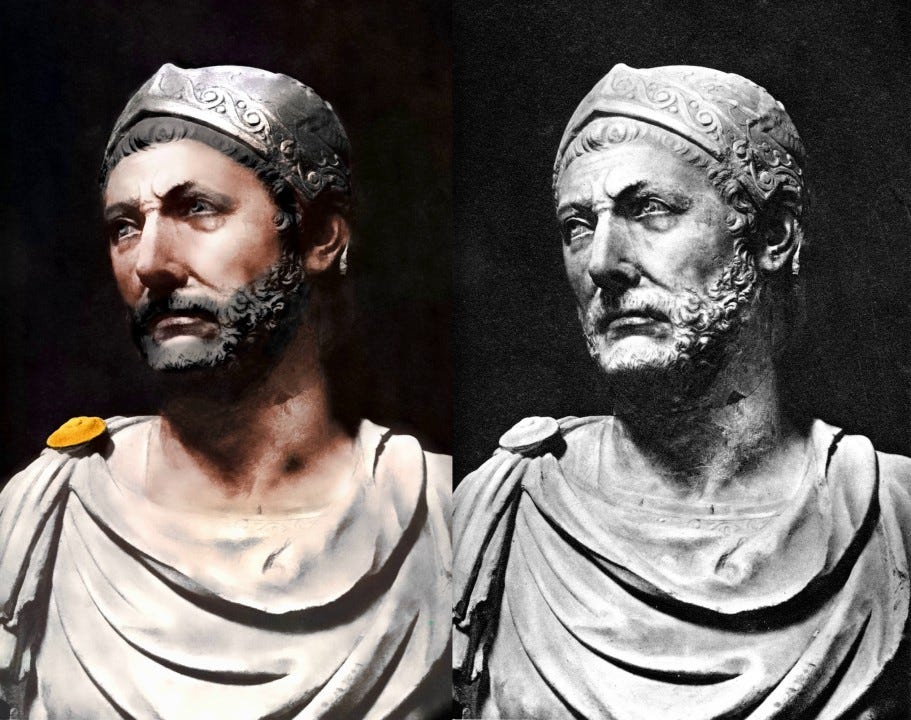
We have updated the page with clear Free Research Roadmap before we finally close the discount window and revert to the $100/month and $1000/year pricing. There is no time limit, we will publish to the exact quality needed to finish these dispatches.
More unannounced free research like this analysis will be published to maintain pace with the news cycle.
Current discount window is open at $50 per month or $500 per year giving you 2 free months.
We will be turning on payments this weekend and will be publishing our first paid only article in 1 or 2 weeks. This does not mean all research will be paywalled. We will be very selective as to what is deliberately redacted to generate the highest value and operational intelligence for paying subscribers.
The discount window closes once the numbered free roadmap is completed.
Thank you for the pledged support.

These articles suck me in like a blackhole, excellent! If we replace Epic with Epstein in the title, we'll have an even clearer picture of the situation ;)
this is one of the best pieces of strategic analysis I've read in months.
The Carthage parallel isn't just literary decoration, it's structurally precise. The interbellum section alone should be required reading for anyone still parroting "strikes set the program back a decade."
You've laid out the distributed enrichment math and the parallel sprint logic so clearly that the policy implications are unavoidable, and deeply uncomfortable. The detail on IR-6 cascade footprints fitting in 1,600 square feet next to a bakery is the kind of thing that should keep nonproliferation analysts up at night.
Maharbal was right, and so are you — half-measures create the very enemy they claim to prevent.
Looking forward to Part 3.